

In This Article
The construction industry is one of the sectors where occupational accidents occur most frequently. Working at height in particular involves serious risks, and personal protective equipment (PPE) plays a vital role in reducing these risks. Among this equipment, the carabiner is one of the basic connecting elements of fall arrest and positioning systems.
What Is a Carabiner?
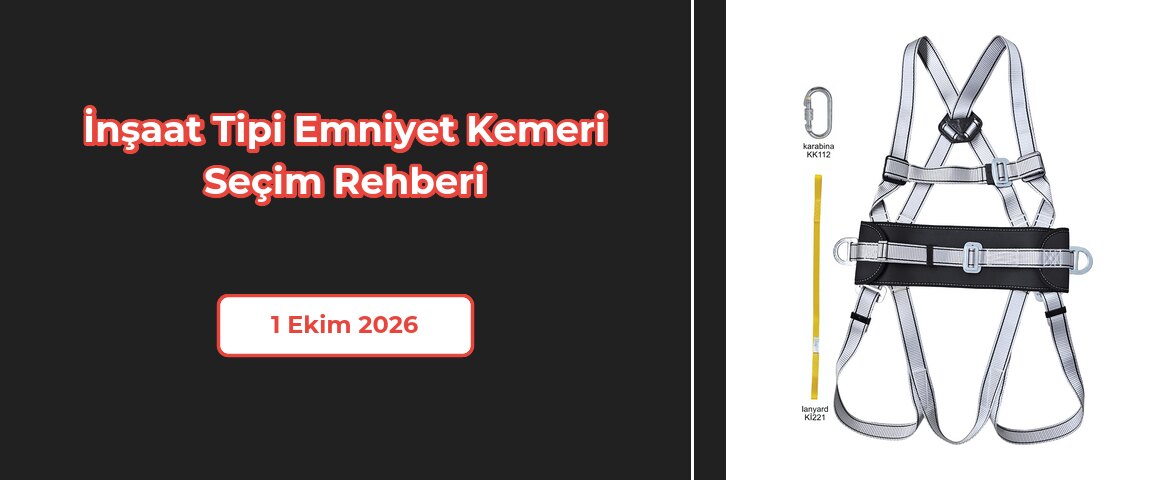
A carabiner is a connecting device, usually made of metal, with a locking or non-locking mechanism, that allows pieces of equipment to be securely connected to each other. On construction sites, it is used to create secure connections between the full body (parachute type) safety harness, the lifeline, ropes and anchor points.
Where Are Carabiners Used in the Construction Industry?
Carabiners serve at many critical points on construction sites:
- Connecting the safety harness of personnel working at height to the lifeline
- Fall arrest systems in scaffolding, platform and roof work
- Securing rope and anchor connections
- Setting up temporary safety lines
- Equipment safety during maintenance and installation work
A carabiner used at the right point saves lives in the event of a fall.
Types of Carabiners and Their Use in Construction
In the construction industry, locking carabiners are generally preferred. These are:
- Auto-locking carabiner: Locks automatically and reduces the margin for error
- Screw-lock carabiner: Provides manual control
- Steel carabiner: Offers high load capacity and durability
Although aluminium carabiners are lightweight, steel carabiners are generally preferred in heavy industrial applications.
What to Consider When Choosing a Carabiner
When choosing carabiners for use on a construction site, the following criteria must always be evaluated:
- Load capacity (kN value)
- Compliance with EN and CE standards
- Reliability of the locking mechanism
- Resistance to corrosion and impact
- Design suitable for the area of use
Products that do not comply with standards can lead to serious accidents.
Occupational Safety Legislation and Carabiner Use
Legislation on working at height makes the use of appropriate personal protective equipment mandatory. Carabiners are an integral part of full body (parachute type) safety harness, lanyard and lifeline systems. Failure to use them, or using them incorrectly, has serious consequences for both the employee and the employer.
Common Mistakes in Carabiner Use
Some of the mistakes frequently encountered on construction sites are:
- Not checking the locking mechanism
- Continuing to use a worn or damaged carabiner
- Connecting to the wrong anchor point
- Using non-standard or unsuitable products
These mistakes are among the most important causes of accidents.
The Importance of Periodic Inspection and Maintenance
Carabiners must be inspected regularly. If problems are detected in particular with:
- The locking mechanism
- Body deformation
- Rust and cracks
the product must be withdrawn from use immediately. Periodic inspections are an indispensable part of a safe working environment.
Carabiner use in the construction industry is critically important for the safety of personnel working at height. With the right choice of carabiner, use in accordance with standards and regular inspections, occupational accidents can be largely prevented. Though it may look like a small part among occupational safety equipment, when used correctly it saves lives.
Let our team recommend the best equipment for your needs and quote you quickly.