In This Article
Hard hats are equipment that must be used to protect the head in work areas, especially on construction sites. They are a very important piece of equipment for occupational health and safety. They must be used to prevent accidents in work areas or to ensure that accidents result in the least possible damage. Hard hat standards should be determined according to what the hard hat is intended to protect against.
They are produced to protect against blows, impacts, falling objects or flying materials. Hard hat standards must be such that they fully ensure the safety of the head. In addition, the materials used in their production also protect against electric shock. Hard hat standards must be such that they protect against problems such as bad weather conditions and UV rays.
Hard Hat Standards and the Features of Their Colours
Hard hats are distinguished by their colours. Hard hat standards are determined according to the intended use and the person who will use the hard hat. Hard hat standards are determined according to the following colours:
- White hard hat,
- Red hard hat,
- Blue hard hat,
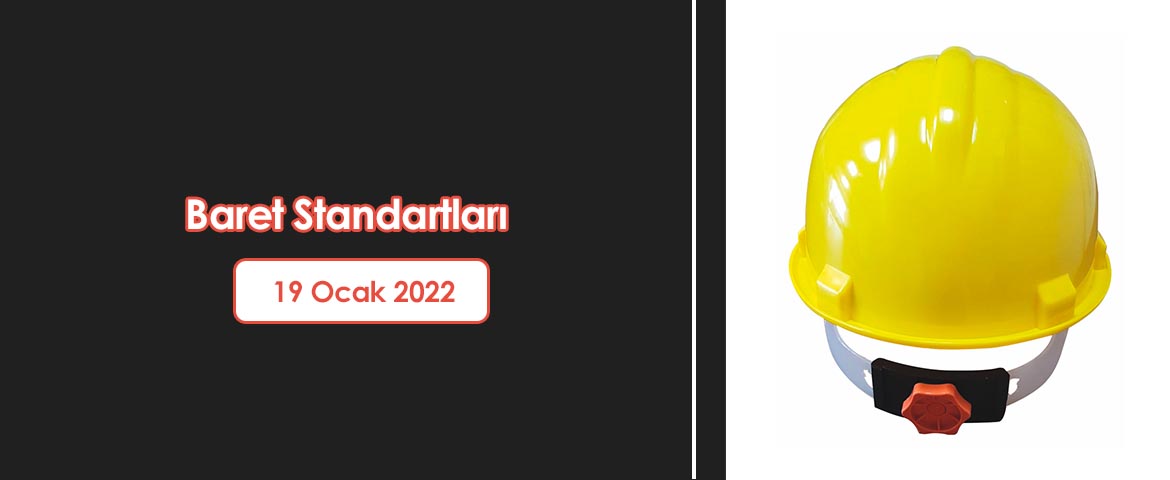
- Yellow hard hat,
- Orange hard hat,
- Green hard hat.
White hard hats are produced for managers, visitors, architects, engineers and technicians. Red hard hats are produced for fire and quality control teams. Blue hard hats are produced for the maintenance team and foremen. While workers use the yellow hard hat, technicians and supervisors use the orange hard hat. The green hard hat is used by healthcare personnel.
Hard Hat Standards and Structure
Hard hats are manufactured to specific dimensions. Otherwise, they would have no protective effect and a safe working environment could not be created. Hard hat standards are determined according to their protectiveness and comfort.
They are manufactured to be resistant to impacts, electricity, moisture, heat, oil, sweat and acidic substances. They must also be able to withstand a voltage of 50 Hz and 2000 V for at least 3 minutes. Hard hat standards must be in 3 sizes. These sizes are 50–54, 54–57 and 57–62 cm. Their structure and features can be listed as follows:
- Hard hat standards generally require a sloping shape extending from front to back.
- The headband inside the hard hat must be adjustable.
- The sweatband must be removable and refittable.
- Hard hats must be manufactured to allow ventilation.
- Hard hat standards generally require that the clearance between the hard hat and the head be adjustable.
- The weight of a hard hat must not exceed 450 grams.
What Are Hard Hat Standards?
Today, in hazardous work areas, types of hard hats must be used in compliance with hard hat standards. Under today's conditions, the use of hard hats is generally very widespread. And hard hat standards are generally the same all over the world. Using hard hats within a specific standard ensures that the various types of hard hats are used more effectively. Today, hard hat standards are observed most in the following areas:
- Construction sites
- Architectural fields
- Areas where the risk of objects falling on the head is high
- Building construction areas
Today, the main purpose of the frequent use of hard hats is to protect the head area from external factors. Being on construction sites without a hard hat in particular carries high risks. For hard hats to be used correctly, attention must always be paid to the types of hard hat standards. Today, the correct use of hard hats is mandatory in some outdoor work areas.
Hard Hat Standards by Colour Meaning
Since hard hats are frequently preferred in various fields, colours and their meanings are included among hard hat standards. Under today's conditions, colours express the same types of hard hat standards all over the world. The colours of today's hard hats and their meanings are as follows:
- Green hard hats indicate healthcare personnel.
- White hard hats indicate visitors, supervisors, architects or technicians.
- The yellow hard hat indicates personnel working as labourers.
- Orange hard hats indicate those working as foremen and technicians.
- Red hard hats indicate quality personnel and fire unit personnel.
- Blue hard hats indicate personnel in the on-site maintenance team.
Today, among hard hat standards for hard hat use, the meanings of colours are generally the most prominent. In this context, it is easy to say that hard hats are products supported by different features. Thus we can say that these products offer a high level of usability.
Hard Hat Standards by Structure
Colours differ among types of hard hats, but all hard hats have the same features. Today, hard hat standards in terms of structure stand out mostly for their general structure. In particular, being protective against sunlight is very important for hard hat standards. Recently, a more careful approach has been taken to the protective features within hard hat standards.
In general, hard hat standards always lead to the correct use of hard hats.
Let our team recommend the best equipment for your needs and quote you quickly.