In This Article
Industrial lanyard selection for heavy industry starts with the site, not the catalogue. In steel mills, foundries, petrochemical plants, power facilities, shipyards and cement works, first identify heat, sparks, chemicals, sharp edges and electrical hazards; then decide whether the worker stays put, travels horizontally or climbs. Material, number of legs, connectors and documentation follow from those two answers.
Why is lanyard selection different in heavy industry?
In heavy industry the same lanyard may touch a hot surface, oil, dust and sharp steel edges within one shift. Selection therefore does not end with "shock-absorbing or twin-leg"; you check whether the limits in the product's user instructions match the real conditions of the plant, and where they do not, you plan additional measures.
On a construction site the risk is often limited to edges and scaffolding, while in a steelworks or refinery several factors overlap during the same shift. The Karam KA341 user instructions state plainly that high temperatures, sharp edges, chemical effects, abrasion and electrical hazards affect the product negatively. A sound choice means that, where you cannot remove these factors, you put in place equipment and working methods that control them.
What information should you collect before choosing?
A good selection begins with a written description of the work area before any purchase request. When the safety specialist carrying out the risk assessment, the maintenance supervisor and the purchasing team work from the same list, the wrong product is kept out of the stores from the start. The inputs below underpin every decision in the following sections:
- Type of work point: crane runway, beam, tank roof, inside a silo, pipe rack, platform, ship block.
- Anchorage options: EN 795 anchor point, horizontal or vertical lifeline, beam anchor trolley, anchor sling.
- Environmental factors: hot surfaces, welding and grinding sparks, acids/solvents, oil, cement and slag dust, moisture.
- Edge conditions: steel section edges, cut sheet metal, gratings, burred surfaces.
- Electricity: whether work takes place near live panels, lines or equipment.
- Movement pattern and shift length, number of users, and how the rescue plan will be carried out.
Choosing the material: static rope, webbing or elastic
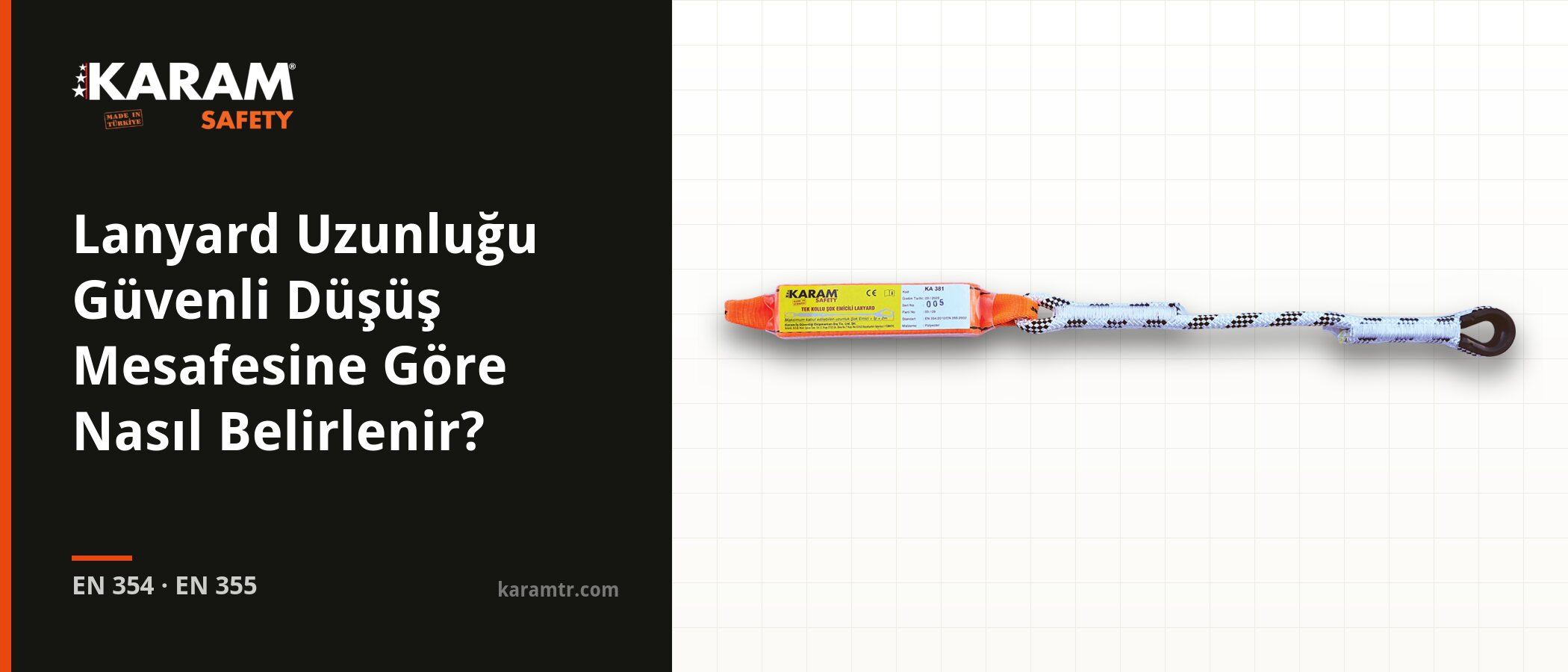
Karam lanyards use three basic body materials: 12 mm polyester static rope, 45 mm polyester webbing and elasticated polyester webbing. The KA341 instructions state that textile parts are polyester and metal parts are steel or aluminium. All three follow the same instruction rules; the difference lies in how they behave on site and in what you need to inspect.
Braided polyester static rope
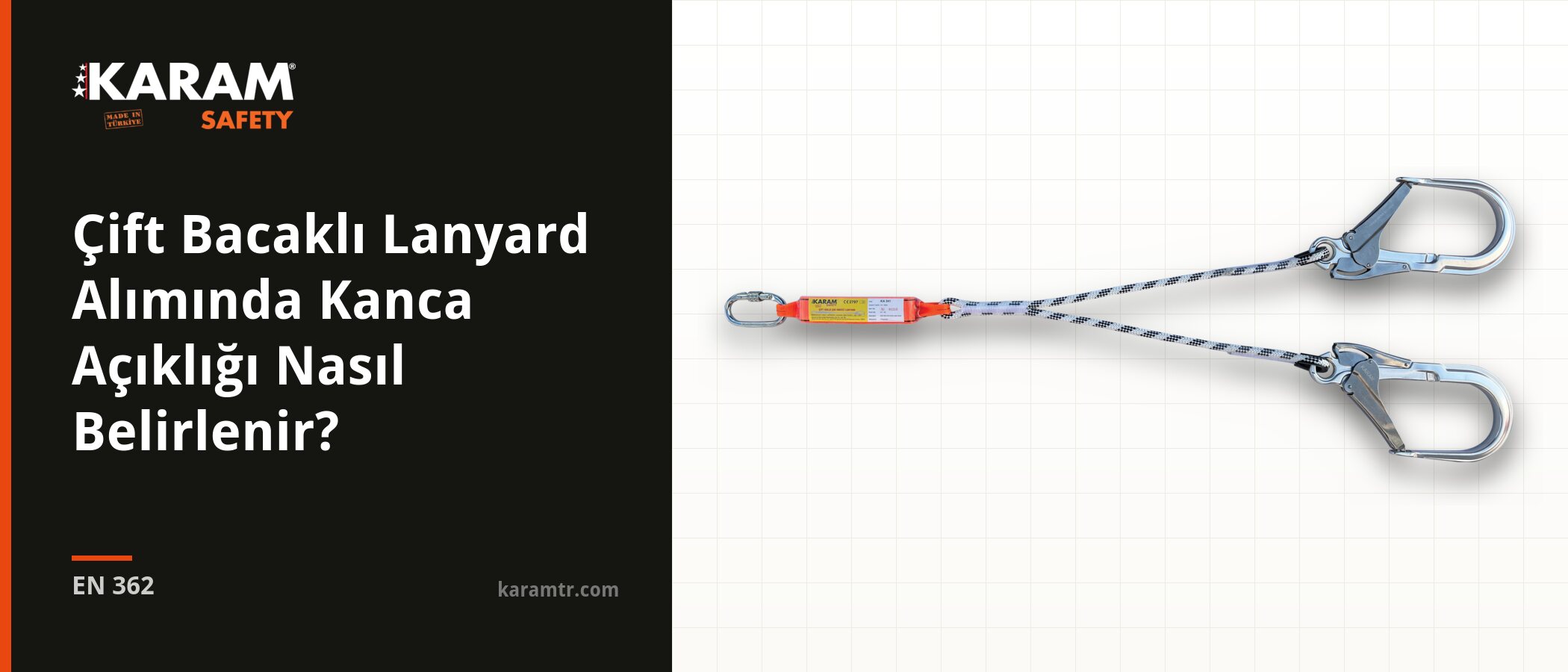
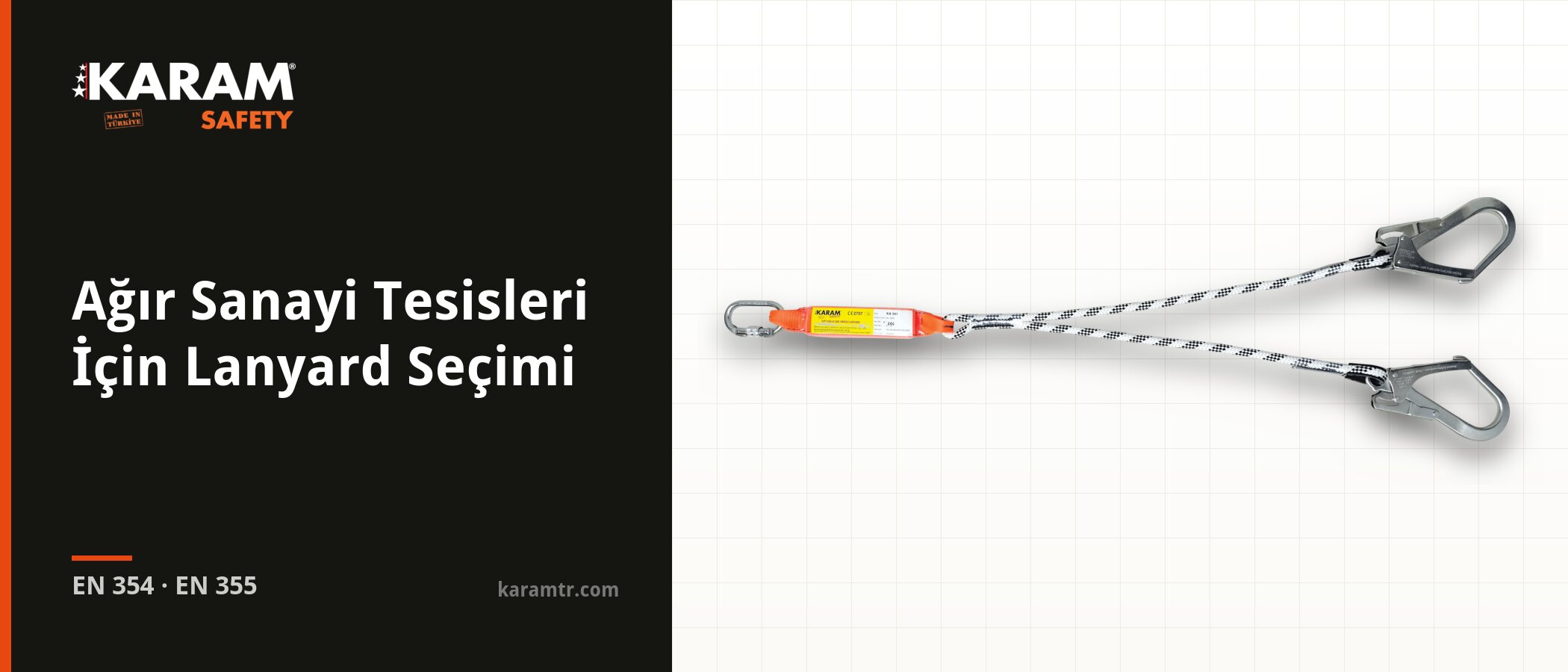
The certificate for the KA341 twin-leg shock-absorbing lanyard describes it as a Y-lanyard made of braided polyester rope with thimble-spliced ends. The same 12 mm static rope is used in the single-leg KA381 and in the twin-leg Kİ231 without an energy absorber. Before each use, check the rope by hand and eye for abrasion marks, broken fibres and colour change; the thimble ends and the energy absorber connection belong to the same check.
Polyester webbing
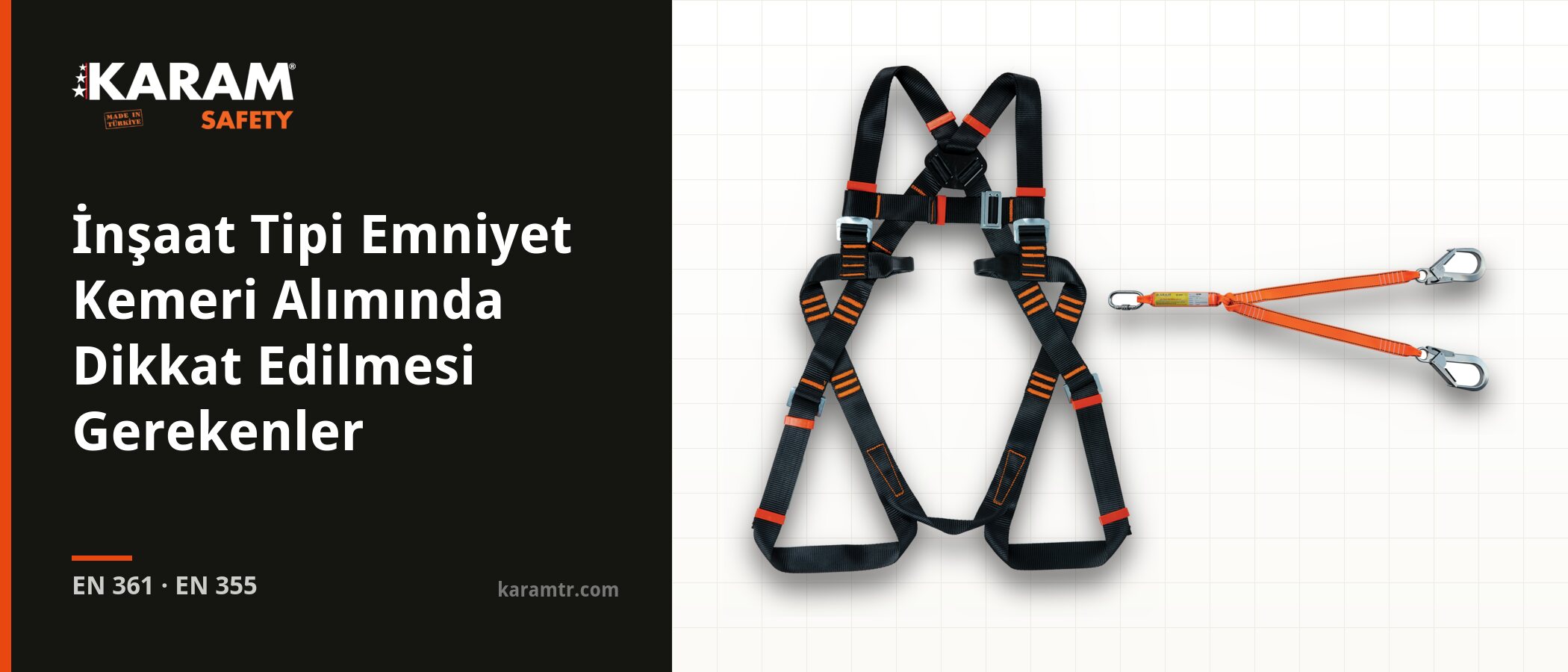
The KA361 twin-leg and KA321 single-leg shock-absorbing lanyards are made from 45 mm polyester webbing; Kİ261 is the twin-leg version of the same webbing without an energy absorber. Webbing and rope models are listed against the same standards (EN 354, EN 355, EN 362); the choice between them often depends on existing plant stock and user preference. Checks for colour change, wear and unpicked stitching matter here, because the inspection list in the instructions looks directly at these three findings.
Elastic webbing
Elastic models shorten when slack and extend when needed. For the Kİ371 twin-leg elastic lanyard and the KA391 single-leg elastic shock absorber, the product pages give a 1 m rope length and a 2 m finished length. This design reduces the lanyard dragging on the floor and snagging while the user moves along platforms and beams. The twin-leg shock-absorbing elastic option is KA371. An elastic body must also be kept away from heat sources and sharp edges.
Environmental factors and the −30 / +70 °C limit
The KA341 instructions require the product to be used between a minimum of −30 °C and a maximum of +70 °C. This range refers to ambient conditions; in heavy industry the real question is whether the lanyard may touch, even briefly, a surface, slag fragment or weld spatter above that limit.
High temperature, sparks and welding
During maintenance in steel mills, foundries and rolling mills, the anchor point and leg direction are planned so that the lanyard does not touch a furnace shell, hot pipe or ladle rim. The instructions require the product to be kept away from heat sources and not exposed directly to heat. Karam product pages do not describe any lanyard as heat- or spark-resistant, so use in hot work must be decided through risk assessment and the welding point kept away from the lanyard path.
Chemicals, oil and dirt
In petrochemical plants and refineries, contact with acids, solvents and hydrocarbons is harmful to synthetic fibres. The instructions say the product must not come into contact with solvents or chemicals and must be stored away from acids and solvents. Cleaning is done with water at no more than 30 °C and a neutral (pH 5.5) detergent, and the product is dried at room temperature. A lanyard suspected of chemical contamination should not be used until a competent person has examined it.
Sharp edges and abrasion
Ship blocks, steel structures and gratings in cement plants mean sharp and abrasive edges. The instructions say contact with such edges must be avoided and, where the risk analysis identifies sharp edges, the necessary measures must be taken. Using edge protection, placing the anchor directly above the edge and not loading the lanyard over the edge are the basic measures. For work positioning, the Kİ248 positioning rope comes with a protective rope sleeve.
Electrical hazards: KK166 and Kİ290
In power plants, substations and electrical maintenance, metal connectors approaching live parts are a separate hazard. The Karam KK166 insulated electrician's hook is made of a steel-reinforced special composite polymer with a moulded finish; its gate opening is 57 mm, minimum breaking strength 23 kN, and it conforms to EN 362:2004 Class T. The Kİ290 insulated fixing lanyard with electrician's hook uses 12 mm static rope.
Two points need attention. First, the product pages give no voltage rating for electrical insulation; the word "insulated" is not permission for live working, and your electrical safety procedure makes that decision. Second, Kİ290 is a fixing lanyard without an energy absorber; in the words of the instructions, a lanyard cannot be used as fall arrest equipment without a shock absorber. When positioning on a pole, plan a separate fall arrest connection as well.
Lanyard selection table by sector
The table below matches common heavy-industry environments with a recommended lanyard type and a key point to watch. It is a pre-screening tool; the final selection is made by a competent person based on your site risk assessment, the combination of equipment used and the product instructions.
| Environment / hazard | Recommended lanyard type | Key point |
|---|---|---|
| Steelworks, foundry: hot surfaces, slag, sparks | Twin-leg shock-absorbing static rope (KA341) or webbing (KA361) | Instruction limit −30 / +70 °C; lanyard path kept clear of hot surfaces and welding points |
| Petrochemical, refinery: solvents, acids, oil | Twin-leg shock-absorbing lanyard, set dedicated to the task | Stop use after chemical contact; clean at 30 °C with neutral detergent |
| Power, electrical maintenance: near live equipment | Kİ290 for positioning; KK166 as connector | Kİ290 has no energy absorber; separate fall arrest link and electrical procedure required |
| Shipyard, ship blocks: sharp edges, moisture | Twin-leg shock-absorbing lanyard; sleeved Kİ248 for positioning | Edge protection, anchor above the edge; dry wet products at room temperature |
| Cement: heavy dust, abrasion | Twin-leg shock-absorbing webbing or static rope | Check for dust and wear at end of shift; clean according to the instructions |
| Crane runway, beams: horizontal travel | Twin-leg shock-absorbing, elastic option that shortens when slack (KA371) | Transfer legs one at a time; never park the free leg on another harness point |
| Tanks, silos: vertical access, confined space | Vertical lifeline or self-retracting fall arrester | Anchor above the user; rescue plan and, where needed, tripod ready |
| Platform, fixed work point | Single-leg shock-absorbing lanyard plus positioning rope if needed | A positioning rope does not replace fall arrest |
If you would like to match these types with Karam products using your own site drawings and job descriptions, send your site details to the Karam team on WhatsApp; the reply comes back with product codes and the relevant document list.
How does the movement pattern decide the lanyard type?
Does the worker stay at one point, travel horizontally or climb vertically? The answer determines the number of legs and the connection layout. The KA341 instructions recommend always choosing a twin-leg shock-absorbing lanyard when work will not be at a fixed point and involves moving left–right or up–down.
Work at a fixed point
For valve maintenance, measurements on a platform or assembly from a single point, a single-leg shock-absorbing lanyard may be sufficient. Karam offers the static rope KA381, the webbing KA321 and the elastic KA391 for this need. The instructions prohibit using two separate single-leg shock-absorbing lanyards side by side in parallel; if two legs are needed, choose a Y- or V-type twin-leg model connected to one energy absorber.
Horizontal travel: crane runways and beams
During overhead crane maintenance, walking on beams and crossing pipe racks, the worker must not be left unattached while passing obstacles. With a twin-leg shock-absorbing lanyard, one leg is not released until the other is clipped to the new point, and the free leg is not attached to another harness point. Where a continuous line exists, a horizontal lifeline or the EN 795 compliant KA15 beam anchor trolley reduces the number of leg transfers.
Vertical climbing, tank and silo access
When accessing tank roofs, silo walls and long vertical ladders, the anchor must stay above the user. For this work Karam offers vertical lifelines and the self-retracting fall arresters (EN 360) range; the KT800 tripod and winch is described on its product page as intended for confined space access. Confirm horizontal use and edge conditions for any retractable device in its own instructions.
Whatever the movement pattern, lanyard length and the clear distance below are assessed together. The KA341 instructions state that, for this product, there must be at least 6.25 m between the anchor and the ground. You will find the components of the calculation and worked examples in our guide to lanyard length and fall clearance.
Single-leg, twin-leg, positioning rope or self-retracting?
These four product types are not interchangeable; each has a different role in the system. The comparison below summarises the points that heavy-industry maintenance teams most often confuse.
| Type | Role | Karam examples | Limit |
|---|---|---|---|
| Single-leg shock-absorbing | Fall arrest at a fixed point | KA381, KA321, KA391 | Two must not be used in parallel |
| Twin-leg shock-absorbing | Continuous attachment while moving | KA341, KA361, KA371 | Free leg not attached to the harness |
| Lanyard without energy absorber | Restraint layouts that prevent a fall, system component | Kİ231, Kİ261, Kİ371 | Not a fall arrester on its own |
| Positioning rope | Holding the user in position with hands free (EN 358) | Kİ244, Kİ248 | Does not replace fall arrest |
| Self-retracting fall arrester | Connection that extends and retracts with vertical movement (EN 360) | Products in the retractable range | Conditions of use per device instructions |
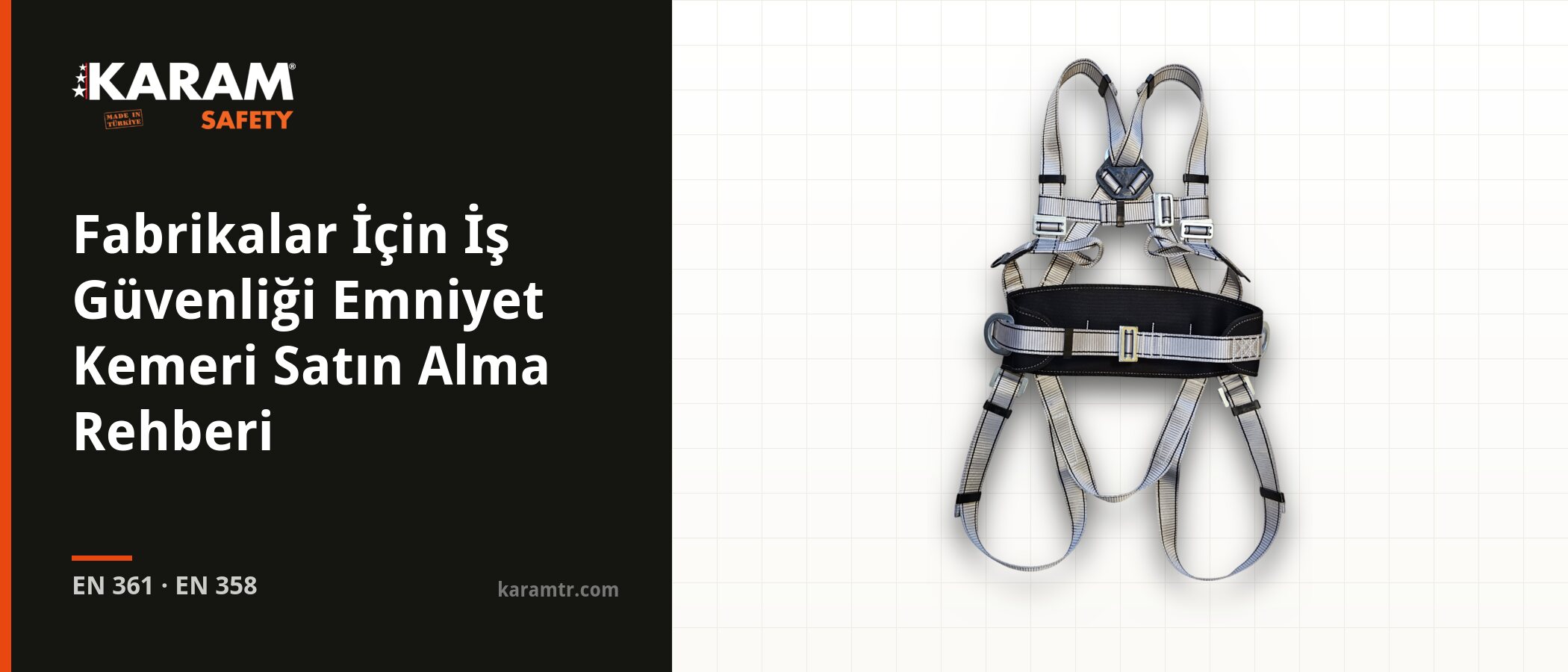
All shock-absorbing models are listed under shock-absorbing lanyards, lanyards without energy absorbers and positioning products under lanyards, and twin-leg models without energy absorbers under twin-leg ropes. Positioning ropes are used with the side D-rings of EN 358 harnesses such as the KP30.
How should connectors be selected?
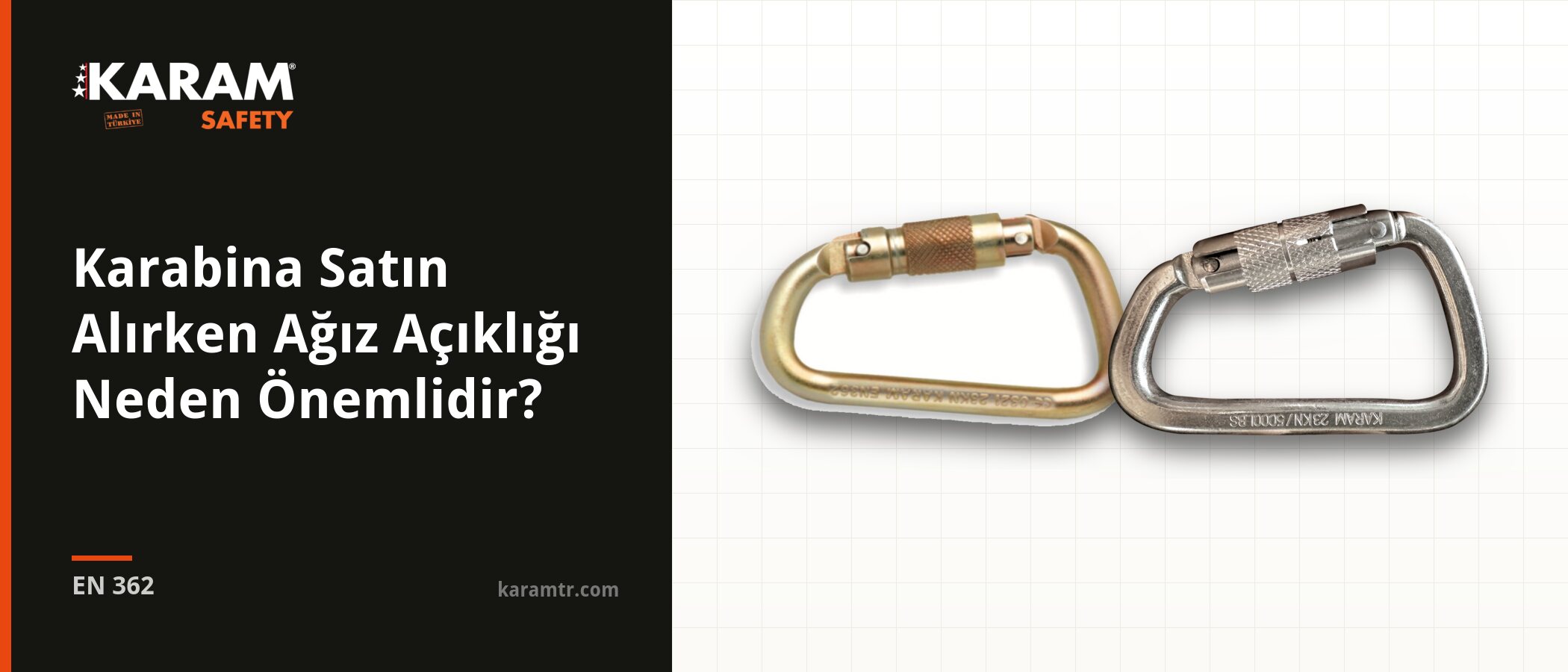
Connectors are chosen according to the thickness of the structural member they attach to, the environment and the workflow. The instructions require the carabiner gate to be locked at all times and loaded along its major axis, preferably using an automatic locking model. Double-locking, wide-gate hooks at the lanyard ends make work easier.
The Karam hook and carabiner ranges cover different needs. The KK114 carabiner is alloy steel with a 22 mm gate opening and 40 kN minimum breaking strength, EN 362:2004 Class B, suitable for the harness-side connection. For thick members such as beams, pipes and sections, consider large hooks such as the KK131 (named 55 mm), the aluminium KK136 (named 63 mm) or the KK138 (named 110 mm). Confirm the exact gate opening against the product label and technical data.
How to size the gate opening for the member you clip onto is a separate topic covered in our guide to twin-leg lanyard hook opening. For heavy industry, one note to add: in salty, humid shipyard conditions or where chemical vapours are present, check metal parts more often for cracks, deformation and corrosion, and test that the gate closes by itself at every use. KY-series spring galvanised carabiners are not PPE connectors and have no place in a fall arrest chain.
Which criteria matter in corporate procurement?
In corporate procurement, lanyards are assessed on the document set, traceability, inspection records and standardisation. If quotes are compared by product code alone, products with missing documents or outside the record system pile up on site. Writing the items below into the purchase specification saves time in audits and internal reviews.
Document set
- EU type-examination certificate (Category III PPE, Module B): EN 354:2010 and EN 355:2002 for KA341, EN 354:2010 for Kİ231.
- Production quality assurance: the 2016/425 Module D quality assurance certificate referred to in the KA341 instructions.
- EU declaration of conformity and user instructions; Karam documents are published on the certificates page.
- EN 362 documents for connectors and EN 361 for the harness; every component of the system is documented separately.
Traceability and inspection records
The KA341 product label shows the product name, maximum product length, year of production, notified body number, standard, serial number, product code and batch number. After each inspection, the instructions recommend recording product type, brand, model, serial number, production, purchase and first-use dates, the next periodic inspection date, any problems found, and the inspector's name and signature.
Transferring these fields directly into the plant's PPE issue system lets you see in one table which lanyard is with which worker and when it was inspected. According to the instructions, the user checks the product before every use and a competent person inspects it at least every 12 months. A product that has arrested a fall is withdrawn from use; repairs may only be carried out by the manufacturer.
Standardisation steps
- Using the environment table, define two or three standard lanyard types for the whole plant.
- For each type, specify a single product code, connector combination and length.
- Define the harness and lanyard as a compatible set; always connect to the fall arrest point marked "A".
- Add the serial-numbered record form and inspection interval to the specification.
- Include user and competent person training in the procurement plan.
To plan harness and kit purchases step by step at factory scale, use our safety harness buying guide for factories alongside this article.
Inspection, storage and withdrawal from use
In heavy industry, what decides a lanyard's service life is often the environment more than the frequency of use. The pre-use check in the instructions covers colour change in webbing or rope, wear, the state of stitching and connection points, and cracks, deformation and corrosion on metal parts. If any of these is found, the product is withdrawn or the manufacturer's opinion is obtained. Service life is stated in the user instructions and can be shorter under heavy-industry conditions; a product that has arrested a fall or is damaged is withdrawn regardless of its age.
For storage, keep the product in its own bag, in a dry place at room temperature, out of direct sunlight and away from chemicals. A damp product is used only after drying at room temperature. A lanyard is not used for lifting loads, is not knotted and its end eye is not choked around a structure. Write these rules into the site instructions so they apply across shift changes too.
Frequently Asked Questions
Is there a difference between an industrial lanyard and a construction lanyard?
The product standards are the same: EN 354 for lanyards and EN 355 for energy absorbers. The difference lies in the conditions of use. Because heat, chemicals, oil, dust and electrical hazards can coexist in an industrial plant, selection is made with an environment table and inspection and record-keeping run more often. The same KA341 can be used on both sites; the usage plan and check frequency change.
Which lanyard should I use in hot environments?
The KA341 instructions give a use range of −30 °C to +70 °C and require the product to be kept away from heat sources. Karam product pages do not describe any lanyard as heat- or spark-resistant. For hot work, plan the anchor and leg direction so the lanyard does not touch hot surfaces or weld spatter, and base the decision on a risk assessment.
Is the KK166 electrician's hook suitable for live working?
KK166 is a hook with a steel-reinforced special composite polymer body, 57 mm gate opening, 23 kN minimum breaking strength and conformity to EN 362:2004 Class T. The product page does not give a voltage rating for electrical insulation. Decisions about working near live equipment must follow the plant's electrical safety procedure and a competent person's assessment.
Can the Kİ290 insulated fixing lanyard be used for fall arrest?
No. Kİ290 is a fixing lanyard with 12 mm static rope and an insulated hook; it has no energy absorber. The KA341 instructions state clearly that a lanyard cannot be used as fall arrest equipment without a shock absorber. While Kİ290 is used for positioning or fixing, plan a separate EN 355 shock-absorbing connection and a suitable anchor for the fall risk.
Is a single-leg lanyard enough for crane runway maintenance?
Moving along crane runways and beams usually requires changing attachment points. The KA341 instructions recommend a twin-leg shock-absorbing lanyard when work is not at a fixed point and movement is required. If a continuous horizontal lifeline or beam anchor trolley is available, the layout may differ; the decision depends on the line type and the risk assessment.
Can a lanyard contaminated with chemicals be cleaned and reused?
The instructions say the product must not contact solvents and chemicals; cleaning is done only with water at no more than 30 °C and a neutral (pH 5.5) detergent. A lanyard suspected of chemical contact should not be used until a competent person has examined it. A product whose history is unknown, or whose fitness is in doubt after inspection, must be withdrawn according to the instructions.
Which documents should I request in corporate purchasing?
The core document set is the EU type-examination certificate (Module B), production quality assurance (Module D), the EU declaration of conformity and the user instructions. The label should show the serial number, batch number and year of production. Request connector and harness documents separately as well. Karam documents can be reviewed on the certificates page, and the WhatsApp line can be used for quotes and document requests.
How can I find out lanyard prices?
Prices depend on product code, connector combination, length, quantity and documentation needs, so no list prices are published on the website. Send your plant type, work points and required quantities to Karam's WhatsApp line, and a tailored quote will be prepared together with suitable product codes and the document set.
In heavy industry, the right lanyard is the one that handles both the environmental factors and the movement pattern, with complete documents and records. Share your plant's work points and hazards, and the Karam team can work out suitable product codes and the document list with you: request a quote and technical information on WhatsApp.
Let our team recommend the best equipment for your needs and quote you quickly.