In This Article
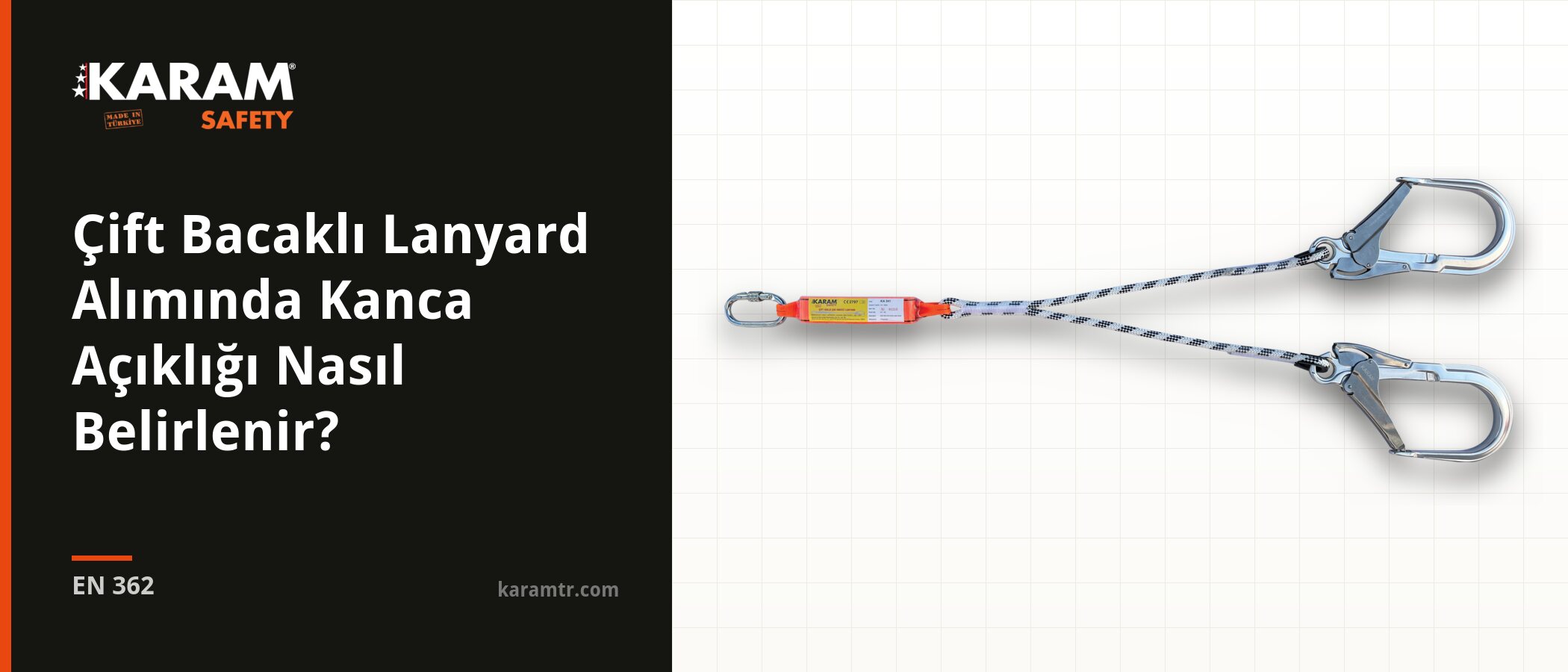
The right twin-leg lanyard hook opening is set by measuring the structure you will clip onto: first measure the widest section of the scaffold tube, beam flange, guardrail or tower member, including any coating, then choose an EN 362 hook whose gate opening is clearly larger, wraps the member completely and closes and locks on its own. Confirm the exact value on the product label.
What does hook opening mean?
Hook opening is the clear gap between the hook body and the tip of the gate when the gate is fully open, the space through which the anchor member enters. On a twin-leg lanyard this figure decides which tubes, profiles or anchor points the two end hooks can be attached to. If the opening is smaller than the member, the hook will not go on; if it is only just large enough, the gate rubs against the member and may not lock fully.
Opening alone is not the whole story. Once the gate has closed, the member must sit freely inside the inner curve of the hook, in the load-bearing part of the body. This article focuses only on the end hooks of a twin-leg lanyard; the general logic of gate openings and connector classes is covered separately in our guide on why carabiner gate opening matters when buying.
Start by measuring the anchor member
Choosing the correct hook starts on site, not in the catalogue. List every structural element the lanyard will be attached to, take a measurement for each one and use the largest value as your reference. If the same crew clips onto both scaffold tubes and steel beams during a shift, either size the hooks for the widest element or specify different lanyards for different work zones.
Measuring tools and method
Measure the outside diameter of tubes and round sections with a caliper, and use a tape measure on large members that a caliper cannot span. Measuring the circumference of a tube with a tape and dividing it by 3.14 gives a practical outside diameter. On profiles and flanges, record separately the thickness and the width of the edge the hook has to wrap. Oval, dented or welded zones can give different readings, so always measure at the exact point where the hook will be attached.
Allowance for coating, insulation and paint
The nominal size on a drawing is not always the size you find on site. Thick paint, galvanising, fireproofing, thermal insulation jackets, rubber guards or cable ties all increase the cross-section. Take your reading over these layers and check that the hook can be put on and taken off without damaging the insulation or coating. In winter, ice and dirt can also stop a gate from closing properly.
Wrapping the member and full gate closure
When the hook is placed on the member, the gate must close fully by itself, without help, and the locking mechanism must engage. If the member presses against the gate, rests on the nose of the hook, or the hook only closes when forced, that hook is not suitable for that member. The KA341 user guide likewise requires the connector gate to be locked at all times and the connector to be loaded along its major axis, the direction of highest strength.
What to measure on each type of structure
The critical dimension differs for each connection element. The table below summarises, for the elements most often found on site, where to measure and which type of hook to consider. Products in the table are examples only; the final choice must be based on your measurement, the risk assessment and the relevant product instructions.
| Connection element | What to measure | Watch out for | Hook to consider / example Karam product |
|---|---|---|---|
| Scaffold tube | Outside diameter including coating | Attach to the plain tube, not over couplers or fittings | Wide-gate double-locking large hook (KK131, KK136) |
| Steel profile / beam flange | Flange thickness and the width of the edge the hook must wrap | Sharp edges and edge loading; a sling or beam anchor is often more suitable | Large hook sized to the measurement; KK138 on wide sections, or an EN 795 beam anchor |
| Guardrail | Outside size of the rail tube or flat bar | A competent person must confirm the guardrail can serve as an anchor | Large hook matching the measurement; otherwise a separate anchor point |
| Lattice tower member | Widest section of the angle or tube member | The hook must not be loaded at an angle on the edge of an angle section | Large hook sized to the member or a tower hook (KK132, confirm the size) |
| Horizontal lifeline | Line fitting or eye of the travelling anchor | The connector requirement in the lifeline system's own manual applies | Connector permitted by the system manual |
| Anchor ear / sling ring | Inner diameter of the eye and material thickness | A large hook can be side-loaded in a small eye; a smaller connector may be needed | EN 362 carabiner or small hook that fits the eye (e.g. KK121) |
As the table shows, the idea that "a bigger hook is always better" is wrong. In small eyes such as an anchor ear or a sling ring, an oversized hook does not seat properly and may be loaded at its tip instead of its body. The right hook takes the member comfortably while still guiding it into the load-bearing curve of the hook.
Karam large hook options
The Karam hooks used on twin-leg lanyards are identified by the size class stated in their product names. The table below brings together the verified information from the product pages. The millimetre value in a product name is a class designation, so we recommend confirming the exact gate opening on the product label or technical information before you buy.
| Product | Size in product name | Material | Strength | Weight | Locking |
|---|---|---|---|---|---|
| KK131 | 55 mm | Forged alloy steel | 25 kN | 494 g | Double-action, EN 362 |
| KK136 | 63 mm | Aluminium | 23 kN | 475 g | Double-action, EN 362 |
| KK138 | 110 mm | Aluminium | 23 kN | 913 g | Double-action, EN 362 |
| KK132 large tower hook | Not stated | Alloy steel | 23 kN | 850 g | Double-action, EN 362 |
For the 55 mm class, see the KK131 large double-locking hook; for the 63 mm class, the KK136 aluminium large hook; and for wide profiles and thick sections, the KK138 110 mm aluminium hook. You can compare all hook and carabiner models in our hooks range.
Connector options defined in the KA341 user guide
The KA341 user guide lists five connector options for the lanyard ends, each with its gate opening, material, strength and EN 362 class. The guide also states that wide-gate, double-locking connectors on the lanyard ends make work easier, and that connectors must be locked, preferably with an automatic locking mechanism.
| Option in the guide | Gate opening | Material | Strength | Standard / class |
|---|---|---|---|---|
| KARAM-1 | 16 mm | Steel | 25 kN | EN 362:2004 Class B |
| KARAM-2 | 55 mm | Steel | 25 kN | EN 362:2004 Class A |
| KARAM-3 | 60 mm | Aluminium | 23 kN | EN 362:2004 Class A |
| KARAM-4 | 110 mm | Aluminium | 23 kN | EN 362:2004 Class A |
| KARAM-5 | 18 mm | Steel | 25 kN | EN 362:2004 Class T |
This table also shows why the confirmation step matters. Some aluminium hooks carry "63 mm" or "63" in their product names, while the large aluminium option in the guide is defined with a 60 mm gate opening. Do not treat 63 as the gate opening; if you are working close to a limit, confirm the exact gate opening on the product label or technical information when ordering. The small 16 mm and 18 mm options are intended for small-eye connection points, not for wide structural members.
Twin-leg lanyards supplied with these hooks
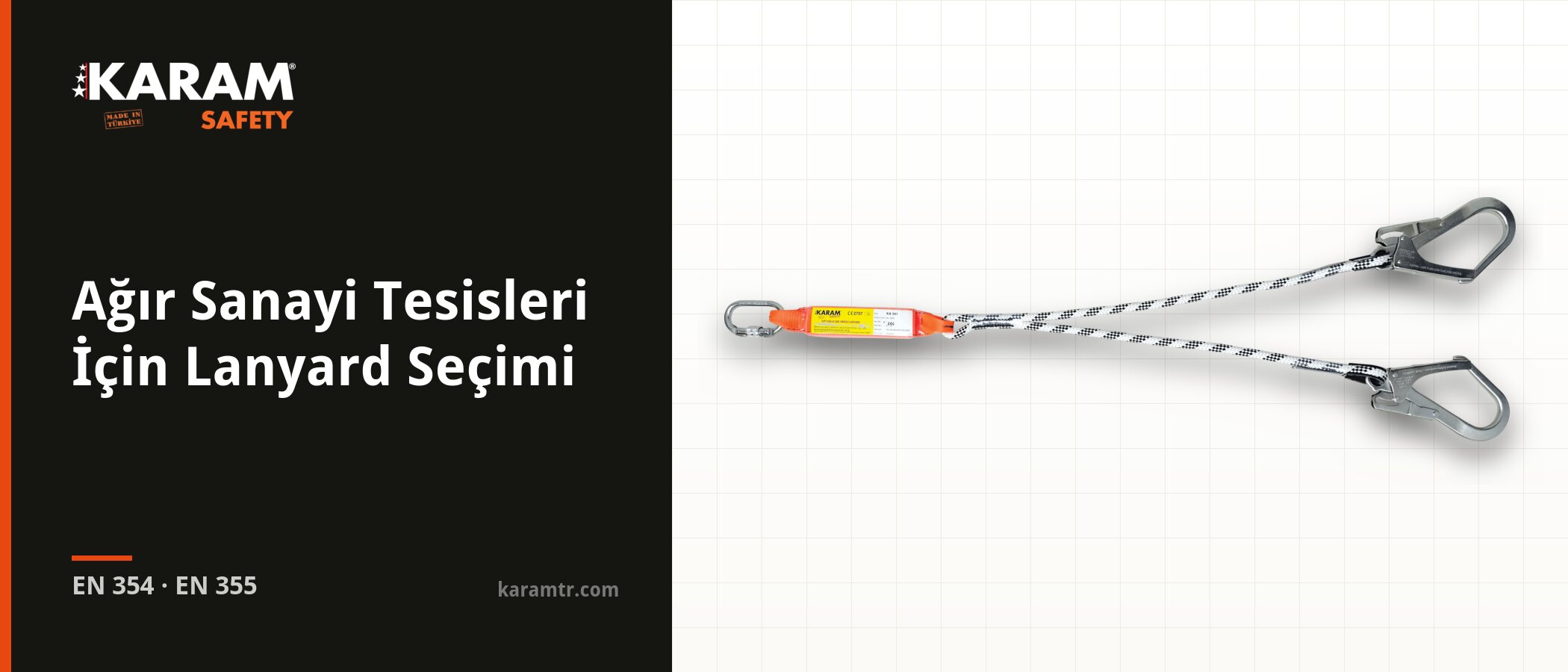
Once the hook size is known, the lanyard should be selected together with that hook as a set. The static rope KA341 twin-leg shock-absorbing lanyard comes with double-locking large hooks. Models whose names include 63 mm aluminium hooks are the KA361 A (webbing) and the KA341 A (static rope); the KA371 A has an elastic body and aluminium hooks. For the widest members, consider the KA341 BA lanyard with 110 hooks.
If you share the dimensions you measured on site and the types of member you will attach to, we can confirm the suitable hook class and label data together with you: send your measurements via WhatsApp.
Steel or aluminium?
Material choice depends on weight, strength and the working environment. According to the product pages, the steel KK131 in the 55 mm class weighs 494 g, the aluminium KK136 in the 63 mm class 475 g, and the aluminium KK138 in the 110 mm class 913 g. On a twin-leg lanyard both end hooks are carried at all times, so these figures count twice on the harness.
The weight difference comes not only from the material but also from the size of the hook. For example, the product pages give total weights of 1,725 g for the KA341, 1,751 g for the KA341 A and 2,537 g for the KA341 BA. For a worker who changes position all day, a difference of several hundred grams is noticeable in fatigue and freedom of movement, so choose the hook that is just right for the measurement rather than simply the largest one.
- Steel hook: With its forged body and 25 kN strength rating (KK131), it suits work with frequent clipping and high wear.
- Aluminium hook: Offers a lighter or wider option within a similar size class; the 63 mm and 110 mm classes are aluminium.
- Environment: For chemical, salty or abrasive environments, confirm material suitability with the manufacturer; the guide requires the product to be withdrawn if chemical contact is even suspected.
Which carabiner goes on the harness end?
The shock absorber end of a twin-leg lanyard connects to the harness with a carabiner, not a large hook. According to the KA341 user guide, this carabiner is attached to the fall arrest attachment point marked "A" on the chest or back of an EN 361 full body harness. At this end, what matters is not a wide gate but an auto-locking carabiner that sits correctly in the D-ring.
The harness-end carabiner is part of the lanyard set and of its certified combination. The guide does not allow any change, addition or repair to the product without the manufacturer's written permission. Rather than swapping end hooks or the harness carabiner on site, choose a lanyard that is supplied with the connector combination you need. If a separate carabiner is required, check its EN 362 conformity and its compatibility with the D-ring.
100% tie-off and changing legs
The whole point of a twin-leg lanyard is that the connection is never broken while you move. This technique is known as 100% tie-off or continuous attachment, and hook choice directly affects whether it can be applied in practice: if the hook does not clip easily onto the next member, the worker may be tempted to have both hooks open at once.
- Keep the first leg attached to the current anchor point and bring the hook of the second leg to the new point.
- Attach the second hook so that it wraps the member completely; check visually and by hand that the gate has closed fully on its own and is locked.
- Only then release the hook of the first leg from the previous point.
- Never open both hooks at the same time; at least one leg must remain attached throughout the transfer.
- Do not clip the unused leg to any attachment point on the harness; the KA341 user guide explicitly prohibits this.
The anchor point should be above the user wherever possible, comply with EN 795 and have a strength of at least 12 kN. The guide also states that two separate single-leg shock-absorbing lanyards must not be used side by side; a Y-type lanyard with a single shock absorber should be used instead. For the transfer technique on horizontal lines, see our article on using twin-leg lanyards on horizontal lifelines.
Avoid gate loading and edge loading
A hook performs close to its rated strength only when it is loaded along the axis of its body. When the opening is wrongly matched to the member, the hook sits at an angle and the member bears on the gate or the nose of the hook, which can prevent the hook from performing as expected. The following situations are the errors most often seen on site.
- The member pressing against the gate, or the gate rubbing on the member as it closes.
- The hook hanging on the member by its nose only.
- The hook tilting sideways under load on the edge of a beam flange or angle section.
- A sharp edge touching the lanyard rope or webbing; the guide requires sharp and abrasive edges to be avoided.
- Two hooks squeezed into the same small eye and transferring load to each other.
- Hooking over a coupler, bolt head or connection plate, creating a position that can slip.
The way to reduce these risks is to take accurate measurements and, where necessary, use a suitable anchor sling or beam anchor instead of clipping the hook directly onto the structure. When a sling is used, check separately that the hook fits the sling ring correctly.
Connector combinations defined in the certificate
The EU type-examination certificate of the KA341 twin-leg lanyard lists the connectors with which the lanyard may be supplied, including carabiner and scaffold hook types. In the same way, the certificate of the Kİ231 twin-leg lanyard defines its EN 362 connector combinations. In other words, the hook is part of the lanyard's certified configuration.
When purchasing, ask whether the hook size you have chosen is among the connector combinations defined in the certificate for that lanyard model. Certificates are available on our certificates page and product instructions in the user guides section. The KA341 certificate covers the requirements of EN 354:2010 and EN 355:2002, and the product is Category III PPE.
How do you determine hook opening step by step?
Hook opening is determined by comparing site measurements with product information. First list and measure every connection element, then choose a hook class that leaves a safe margin over the largest measurement, and finally confirm that the hook is part of the lanyard's certified configuration and check its label value. The process consists of the following steps.
- List every connection point in the work plan: scaffold tube, beam, guardrail, tower member, lifeline, anchor ear.
- Measure the widest section of each element at the actual attachment point, including coating and insulation, with a caliper or tape measure.
- Have a competent person confirm that the element can be used as an anchor; check EN 795 conformity and the minimum 12 kN strength requirement.
- Take the largest measurement as the reference and choose a hook class whose gate closes without touching the member.
- For small eyes, assess separately whether a large hook would be tip-loaded; specify a different connector if needed.
- Compare steel and aluminium options for weight and environmental conditions.
- Confirm that the chosen hook is among the connector combinations defined in the certificate for the lanyard model, and confirm the exact gate opening on the product label or technical information.
- Before first use, try the hook on the real member; check that the gate closes fully and that changing legs is easy.
Illustrative example: scaffold and steelwork together
This example is an illustrative scenario intended only to show the method. Assume a maintenance crew will work on a scaffold and on a steel structure on the same day. The scaffold tube, measured with its coating, proves suitable for comfortable closure with the hook described as 55 mm in its product name; however, the section of the beam flange that the hook must wrap is clearly above that class.
Three options are then considered: the KA341 BA, with hooks described as 110 mm in the product name, sized for the widest element for the whole crew; a lighter-hook lanyard in the scaffold zone and a beam anchor or anchor sling in the beam zone; or two different lanyard specifications by work zone. A competent person makes the decision, weighing weight, frequency of transfers and the suitability of the anchor points. The measurements in this example do not belong to a real project.
Purchasing checklist
- Is the measurement list for the connection elements ready, with the coating allowance added?
- Has the hook size been confirmed against the gate opening on the label, not just the class in the product name?
- Is the hook double-locking (double-action) and EN 362 compliant?
- Is the chosen hook among the connector combinations defined in the lanyard certificate?
- Is the lanyard no longer than 2 m including the shock absorber and connectors, and has fall clearance been calculated for that length?
- Is the harness-end carabiner compatible with the "A" marked point of the EN 361 harness?
- Have users been trained in 100% tie-off and in not clipping the unused leg to the harness?
- Will the user guide and certificate be delivered with the product?
Lanyard length and hook size influence each other, since larger hooks can add to the connector allowance. For length and fall clearance calculations, see our guide on lanyard length and fall clearance. For harness and connection set-up on scaffolds, our article on safety harnesses for scaffold work will help.
Pre-use hook inspection
Even a correctly sized hook needs regular inspection. The KA341 user guide requires the product to be checked by the user before every use and periodically by a competent person at least once every 12 months. Checks should confirm that the gate opens and closes fully, the locking mechanism works properly and there are no cracks, deformation, corrosion or excessive wear on the metal parts.
A product that has arrested a fall, been exposed to a high shock load or failed an inspection must be withdrawn from service. The product's operating temperature range is −30 °C to +70 °C. A rescue plan must also be in place for any emergency during work at height. No knots should be tied in the lanyard, and the end loops must not be used in a choke configuration.
Frequently Asked Questions
What hook opening should a twin-leg lanyard have?
There is no single universal value. The opening must be clearly larger than the widest section of the member, including coating, and the gate must close fully without touching the member. Karam offers hook classes described as 55 mm, 63 mm and 110 mm in their product names; confirm the exact value on the product label.
Which hook is suitable for a scaffold tube?
Measure the outside diameter of the scaffold tube including coating and choose a double-locking large hook that takes that size comfortably. KK131 and KK136 are examples worth considering. Attach the hook to the plain tube rather than over a coupler or fitting, and check that the gate closes fully.
Is a bigger hook always safer?
No. An oversized hook does not seat properly in small eyes such as an anchor ear or sling ring and may be loaded at its tip instead of its body. It also adds weight: the KK138 weighs 913 g and the KK136 475 g. The right hook is one that fits the measurement and seats the member in its load-bearing curve.
Is the 63 mm in the product name the gate opening?
The value in the product name defines the hook class. The connector type table in the KA341 user guide lists a 60 mm gate opening for the large aluminium hook. If you are working close to a limit, confirm the exact gate opening on the product label or technical information; you can contact us via WhatsApp for this.
Can I replace a hook with another one on site?
This is not recommended. The KA341 user guide does not permit any modification or addition to the product without the manufacturer's written permission, and the lanyard certificate lists defined connector combinations. If you need a different hook size, choose the lanyard model that is supplied with that hook.
Can I clip the unused leg to the side ring of my harness?
No. The KA341 user guide states that the unused leg of a Y-type lanyard must not be attached to any attachment point of the full body harness. The free leg should stay available for the move to the next anchor point, and at least one leg must always remain attached during the transfer.
Can a hook be attached directly to a beam flange?
Only if the hook wraps the flange completely, the gate closes fully, the edge does not tilt the hook sideways and a competent person has approved the element as an anchor. In most cases, an EN 795 beam anchor or anchor sling reduces the risk of edge and corner loading.
How can I get a price for a twin-leg lanyard with large hooks?
Prices depend on choices such as hook class, lanyard body, length and quantity, so quotes are prepared based on your measurements. Send us your member types and preferred model on WhatsApp, and we will confirm the suitable hook class and get back to you.
Let our team recommend the best equipment for your needs and quote you quickly.