
In This Article
When buying a construction safety harness, check the anchorage points each task needs, the standards printed on the harness's own certificate (EN 361, plus EN 358 and EN 813 where required), capacity for the user with tools, all-day ergonomics, resistance to site conditions, a compatible twin-leg shock-absorbing lanyard and an acceptance check on delivery. The specification, not the product name, should drive the decision.
How do you define the need before buying?
Define the need by listing the site's work packages, the number of people in each and the anchorage system they will connect to. Without that list, a bulk order usually sends an over-equipped harness to one crew and an under-equipped one to another. A purchase request should start with a short needs form signed jointly by the safety specialist and the site manager.
- Work package and duration (e.g. formwork throughout the structural phase, assembly only during the facade phase).
- Number of people per package and shift pattern.
- Body measurements of the users and their approximate mass including the tools they carry.
- The structural element they will connect to: scaffold tube, steel beam, anchor point, lifeline.
- Free height below the anchorage and how the rescue plan will be carried out.
If the basic logic of harness selection is not yet settled, we recommend reading our construction harness selection guide first; this article focuses on the purchasing side of that choice: specification, delivery acceptance and site logistics.
How should "construction harness" be written in a specification?
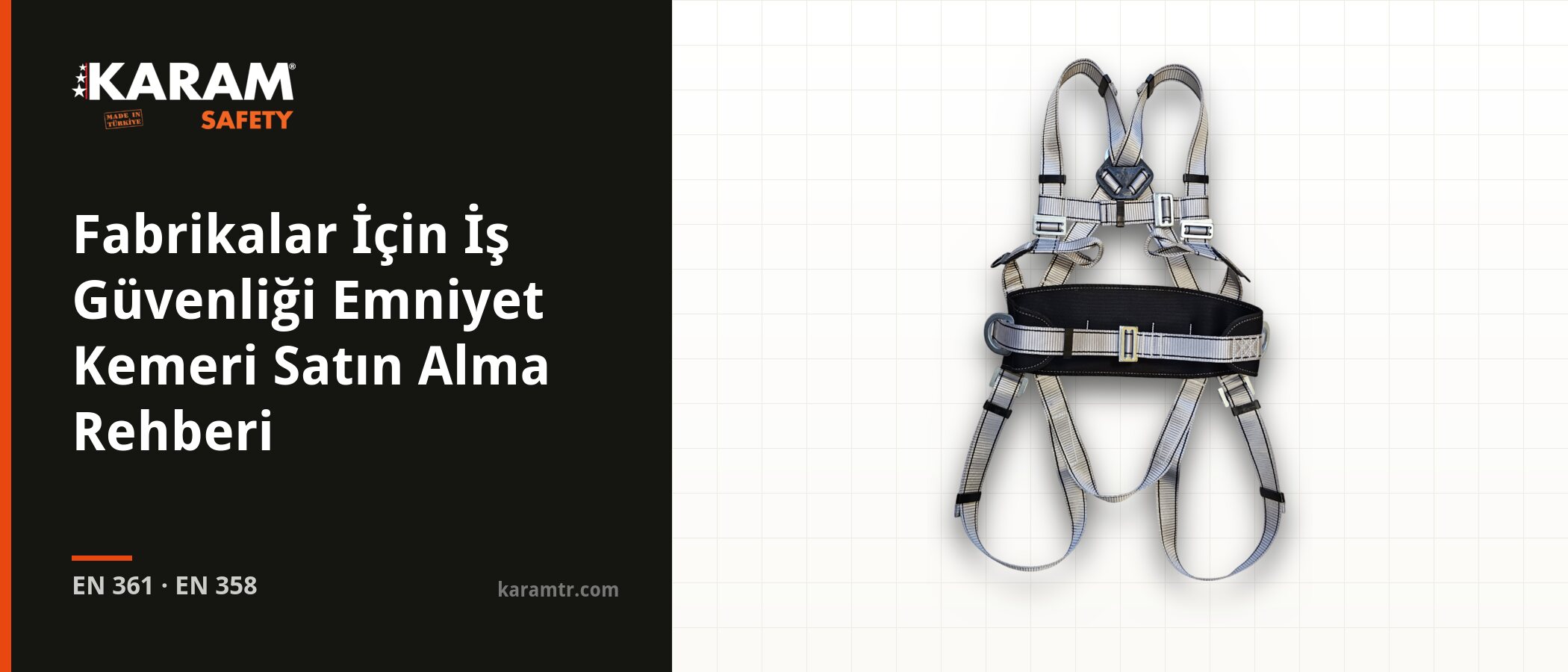
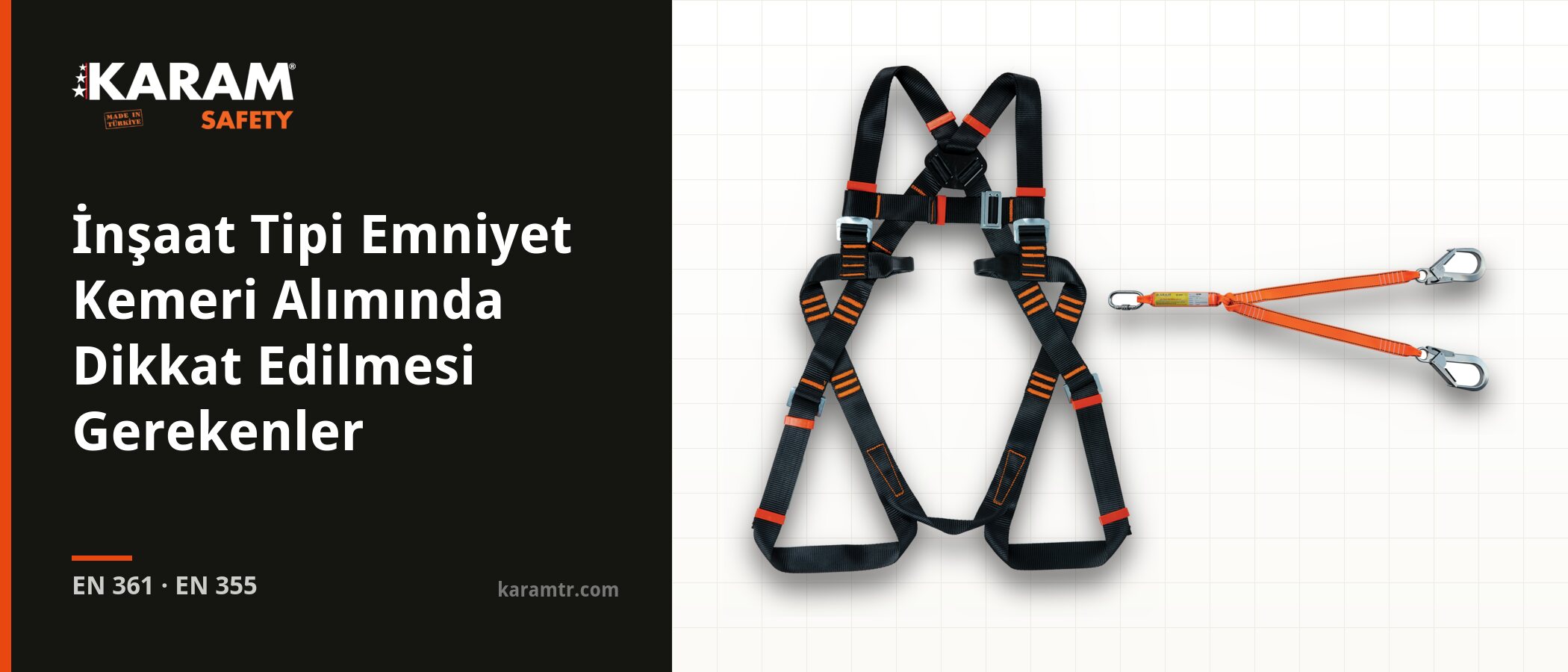
"Construction harness" is not the name of a standard; it is a common trade term. It usually describes a full body harness with a waist belt and side positioning rings. In a specification, write EN 361 full body harness instead, adding EN 358 where work positioning is needed and EN 813 where a sit harness function is needed.
This distinction makes quotations comparable. If a request simply says "construction harness", one supplier may offer a basic harness with a single back ring and another a five-ring model with sit support; both carry the same label but do not do the same job. When the specification states the standard, ring positions, capacity and size distribution, offers can genuinely be compared.
Karam harness certificates state Category III PPE, Regulation (EU) 2016/425 and EU type-examination (Module B). Adding a clause such as "the product's own EU type-examination certificate and EU declaration of conformity shall be supplied on delivery" also makes record-keeping easier under the Turkish PPE Regulation aligned with 2016/425/EU and the regulation on the use of PPE at work. Current documents are available on our certificates page.
Harness and lanyard configuration by work package
Each work package on site calls for a different connection set-up. The table below can serve as a starting point when preparing the purchase list; the final configuration is set by a site-specific risk assessment and the decision of a competent person.
| Work package | Recommended harness feature | Suitable lanyard / additional equipment |
|---|---|---|
| Formwork and rebar | EN 361 + EN 358, back D-ring and two side positioning rings, waist support (e.g. KP10, KP30) | Adjustable positioning rope + a twin-leg shock-absorbing lanyard (KA341 or KA361) for a separate fall arrest connection |
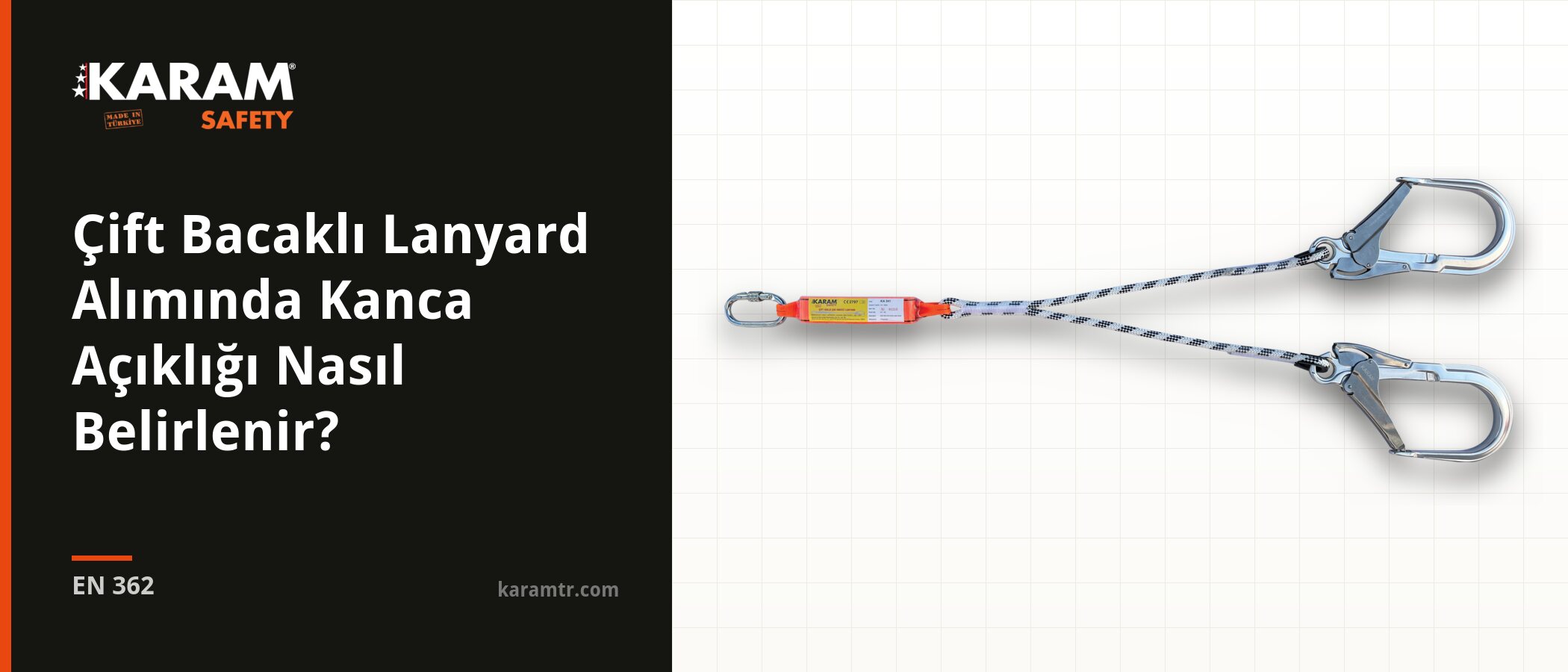
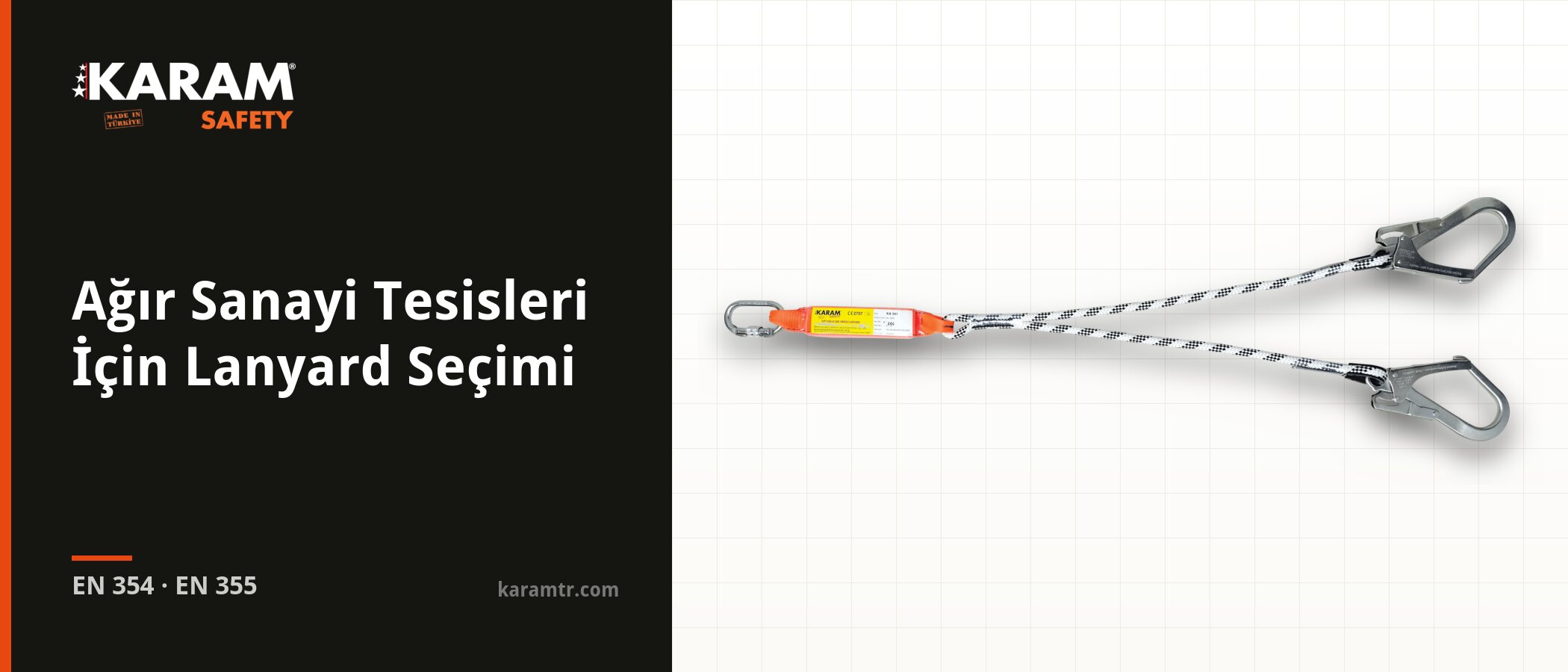
| Scaffold erection and dismantling | EN 361, back D-ring; a light harness for frequent bending and climbing (e.g. KP37, KP30) | Twin-leg shock-absorbing lanyard with large hooks suited to the tube; hook selection follows the tube's outside diameter |
| Facade installation | EN 361 + EN 358 where positioning is needed (KP30); EN 813 too where prolonged suspension is possible (KP45) | Twin-leg shock-absorbing lanyard, positioning rope, suitable anchorage connector |
| Roof work | EN 361, back D-ring; side rings where positioning at the edge is needed | Horizontal lifeline or anchor points + twin-leg shock-absorbing lanyard; edge contact assessed per the manual |
| Steel erection | EN 361 + EN 358, side rings and tool loops; a padded model for long shifts (KP45) | Twin-leg lanyard for continuous attachment, large hook or anchor sling suited to the beam |
| Lift shaft | EN 361 with back or chest attachment point (e.g. KP30 with chest loops, KP37 K) | EN 795 anchor above the shaft + EN 360 retractable fall arrester; fall clearance check is essential |
| Tower crane climbing and maintenance | EN 361 harness with a chest attachment point for vertical access (e.g. KP30 with chest loops, KP45) | Vertical lifeline or retractable fall arrester matching the crane's access system; the crane manufacturer's instructions apply |
The model codes in the table are examples. For the formwork crew, for instance, the KP30 fall arrest and positioning harness accepts a positioning rope thanks to its side rings; however, a positioning rope does not arrest a fall. As our manuals state, a work positioning belt is not used for fall arrest; the same worker must also be connected to a fall arrest system via the back D-ring.
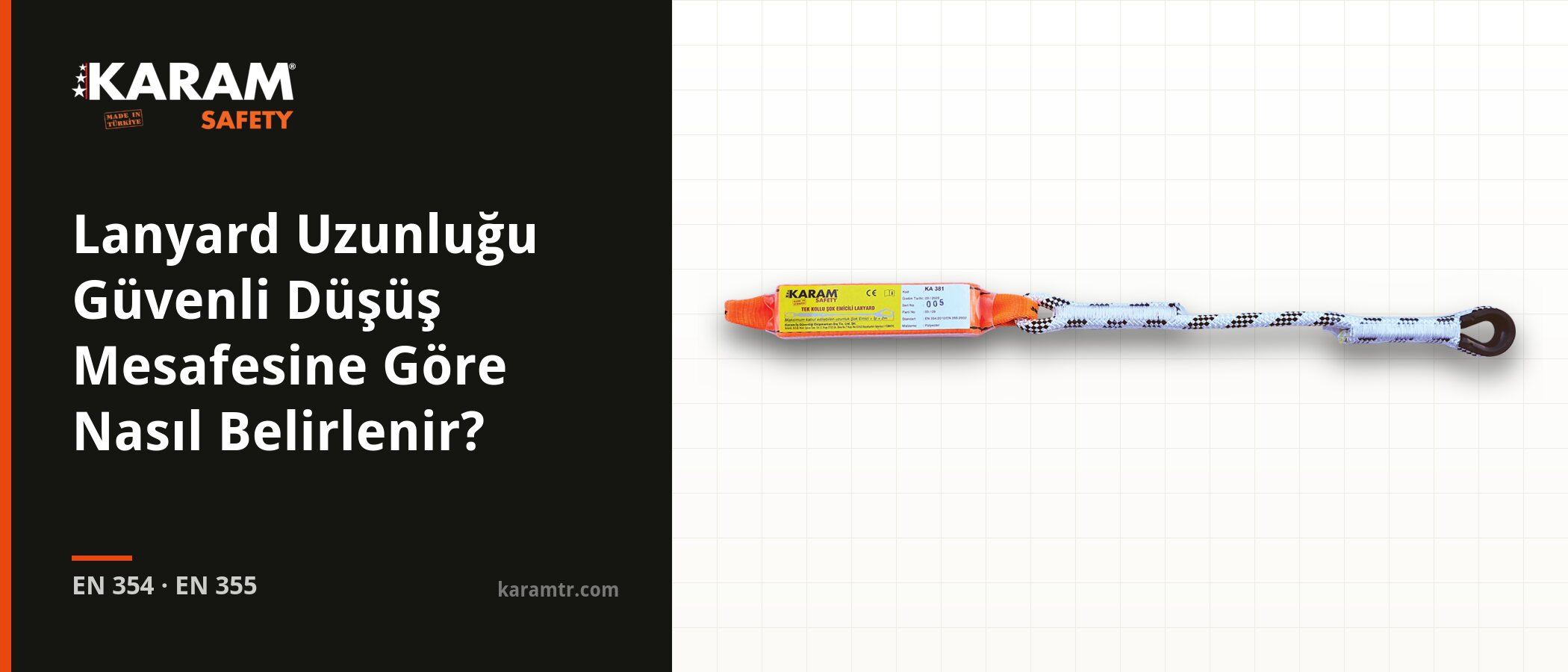
In low, confined spaces such as lift shafts, the deployment length of a shock-absorbing lanyard can be a problem. The KA341 manual requires a free height of at least 6.25 m between the anchorage and the ground for that product. For shorter distances a retractable fall arrester is considered; our retractable fall arresters range and our article on lanyard length and fall clearance can guide you.
How do you decide on the number of attachment points?
The number of attachment points is planned per crew, according to the work each person will do, not per harness. Buying a five-ring harness for everyone adds weight and cost; buying a back-ring-only harness for everyone leaves those who need positioning unprotected. The right ratio comes from the work package list.
- Back (dorsal) D-ring: Present on every full body harness and the primary fall arrest attachment point. Points marked "A" on the harness are fall arrest attachment points.
- Chest (sternal) attachment: Preferred on vertical ladders, in climbing tasks such as tower cranes and where a front connection is practical. KP30 with chest loops and KP37 K have chest attachment; KP45 has two front rings.
- Side positioning rings: For a positioning rope only. Needed in tasks such as formwork, rebar, columns and facades where both hands must be free; a shock-absorbing lanyard is never attached to a side ring.
An illustrative example: if, in a 30-person structural crew, 12 people work on formwork and rebar, 10 on scaffolding and 8 at slab edges, the need for side-ring harnesses with EN 358 conformity may be limited to 12 people. A basic EN 361 harness with a back ring may be sufficient for the other 18. This ratio is only a planning example; the actual split is set by the work packages and the risk assessment.
How do you assess ergonomics for all-day use?
Ergonomics determines whether a harness stays correctly fitted throughout the shift. In purchasing, look at three things: the harness weight, the padding (back, shoulder, waist, legs) and the tool loops for carrying equipment. An uncomfortable harness gets worn loose, and a loosely worn harness may not perform as expected in a fall.
The weights on the product pages give a concrete measure for the decision: KP10 1.58 kg, KP37 1.68 kg, KP30 1.83 kg, KP30 with chest loops 2.05 kg, KP45 AO 2.35 kg and KP45 2.40 kg. A light harness is an advantage in scaffold work with frequent climbing. A heavier but padded harness is easier to wear in steel and facade installation where people work at one spot for long periods.
The KP45 technical data sheet lists padded back, shoulder, waist and leg pads; the KP10 and KP30 manuals state that the waist pad is made of EVA. The KP45 full protection safety harness also comes with 2 fall indicators and 2 tool loops; KP45 AO has automatic buckles and 2+2 tool loops. Automatic buckles save time on harnesses that are put on and taken off frequently during the day.
Tool loops make carrying tools easier, but they are not fall arrest points. For tools that could be dropped, the Kİ01 single and Kİ02 double tool holders can be attached to the harness; the product page gives a carrying capacity of 2.5 kg for Kİ01. The weight of tools should be added to the user's mass in the capacity check.
Capacity: user, tools and the whole system
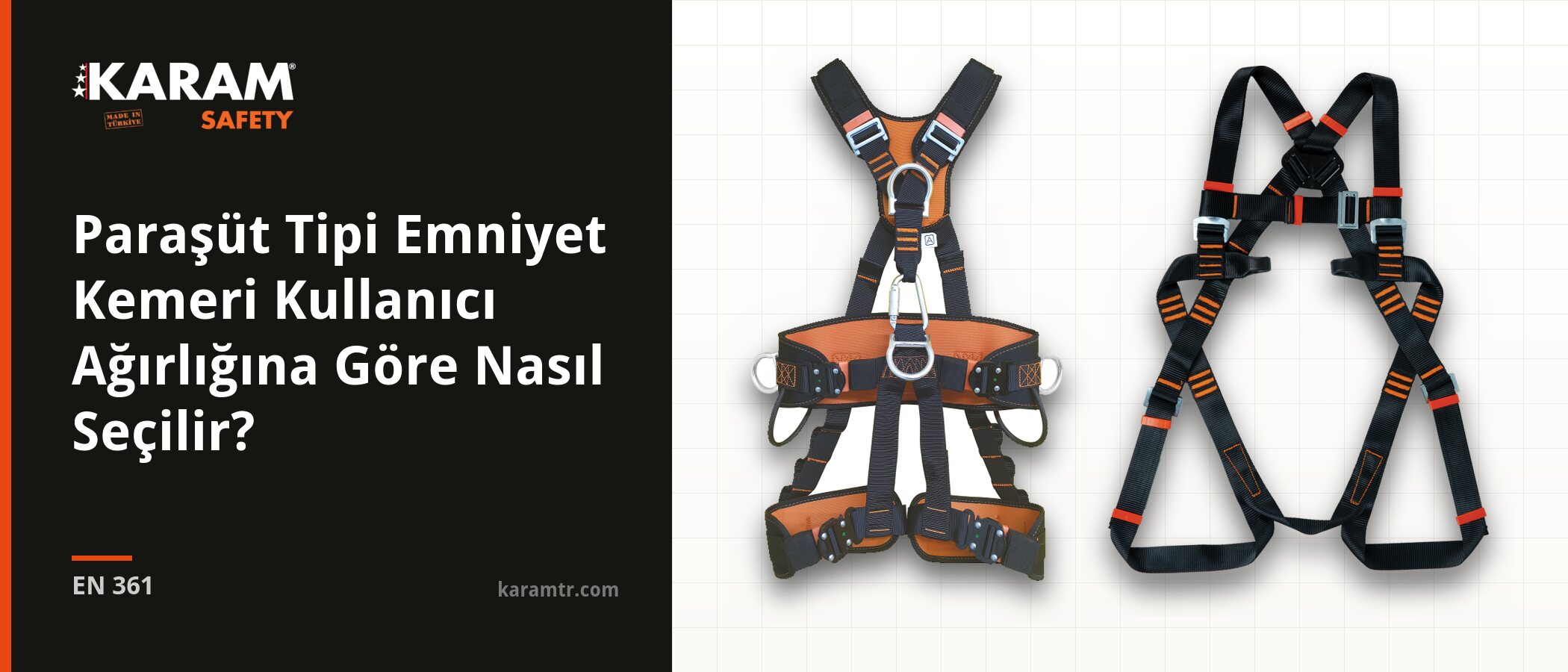
Capacity is assessed according to the most limited component in the system, not just the harness label. The maximum rated load is documented as 150 kg for KP45 and KP45 AO and 125 kg for KP30 and KP37. These values should be considered for the user together with the tools and equipment they carry.
A 150 kg harness does not mean the connected lanyard has the same capacity. The EN 355 energy absorber test is carried out with a 100 kg test mass; use above 100 kg depends on testing documented by the manufacturer. In crews with heavier users, the lanyard's own manual and label must therefore be checked too. For a detailed assessment see our article on choosing a harness by user weight. Size, user mass and capacity are different concepts; a larger size does not mean a higher capacity.
What should be done about dust, mud, concrete and sunlight?
On a construction site, what determines a harness's life is not the day it was bought but how it is used, cleaned and stored. That is why the purchase plan should also include a harness cabinet, a drying area and cleaning instructions. The care rules in the manuals should be shared with the crew on the day of delivery.
Karam harness and lanyard manuals require cleaning with water at a maximum of 30 °C and a neutral (pH 5.5) detergent, drying at room temperature and no exposure to direct heat sources. The product must not come into contact with solvents or chemicals. If contact with form oil, cement mortar or other chemicals is suspected, the product should be shown to a competent person before it is used again.
For storage, the product is kept in a dry place, out of direct sunlight and at room temperature, away from harmful substances such as acids and solvents. A product that becomes damp in storage is dried at room temperature before use. In transport, the product is carried in its own box, away from moisture and chemicals and without contact with other objects. In practice, this means not putting harnesses on the same shelf as rebar, formwork materials or fuel in the site container.
The pre-use check looks for colour change and wear on the webbing, unpicked stitching, broken or cracked buckles, and cracks, deformation or corrosion on metal parts. On muddy, dusty sites, the harness has to be laid out on a flat surface in good light for this check to be done properly; the manuals describe the inspection in exactly this way.
Should you buy a kit or separate items?
Buying the harness and twin-leg lanyard together simplifies compatibility, ordering and issuing; buying them separately gives flexibility to match a different lanyard to each work package. A kit may be more practical for large crews doing one type of work, separate purchases for mixed work packages.
Karam's ready-made kits pair a harness with a KA341 (12 mm polyester static rope) or KA361 (45 mm polyester webbing) twin-leg shock-absorbing lanyard. When assessing standards, look at the harness's and lanyard's own certificate, manual and label data rather than the summary on the kit page. If you see a difference between the kit page summary and the component's own document, the component's document prevails.
| Kit | Harness and attachment points | Documented harness standards | Lanyard body |
|---|---|---|---|
| KP37 + KA341 (374) | KP37, 1 steel D-ring at the back | EN 361 | KA341, static rope |
| KP37 + KA361 (373) | KP37, 1 steel D-ring at the back | EN 361 | KA361, webbing |
| KP30 + KA341 (375) | KP30, 1 back + 2 side D-rings | EN 361 + EN 358 | KA341, static rope |
| KP30 + KA361 (362) | KP30, 1 back + 2 side D-rings | EN 361 + EN 358 | KA361, webbing |
| KP10 + KA341 (372) | KP10, 1 back + 2 side D-rings | EN 361 + EN 358 | KA341, static rope |
| KP10 + KA361 (376) | KP10, 1 back + 2 side D-rings | EN 361 + EN 358 | KA361, webbing |
| KP45 + KA341 (358) | KP45, 1 back + 2 front + 2 side D-rings | EN 361 + EN 358 + EN 813 | KA341, static rope |
The KA341 twin-leg shock-absorbing lanyard is certified to EN 354:2010 and EN 355:2002; according to its manual, the energy absorber is designed to keep the impact force on the user below 6 kN in a fall. For the KA361 twin-leg webbing lanyard, the product page lists EN 354, EN 355 and EN 362. For a positioning crew, for example, the KP30 + KA341 kit can be considered, and the KP37 kits for slab-edge and scaffold crews.
The lanyard length must also be stated separately in the order. The product pages list more than one length option for KA341 and KA361; which length comes in the kit should be confirmed at the quotation stage. The legal maximum lanyard length, including the energy absorber and connectors, is 2 m, and the unused leg must not be attached to another loop on the harness.
Do scaffold tubes require a large hook?
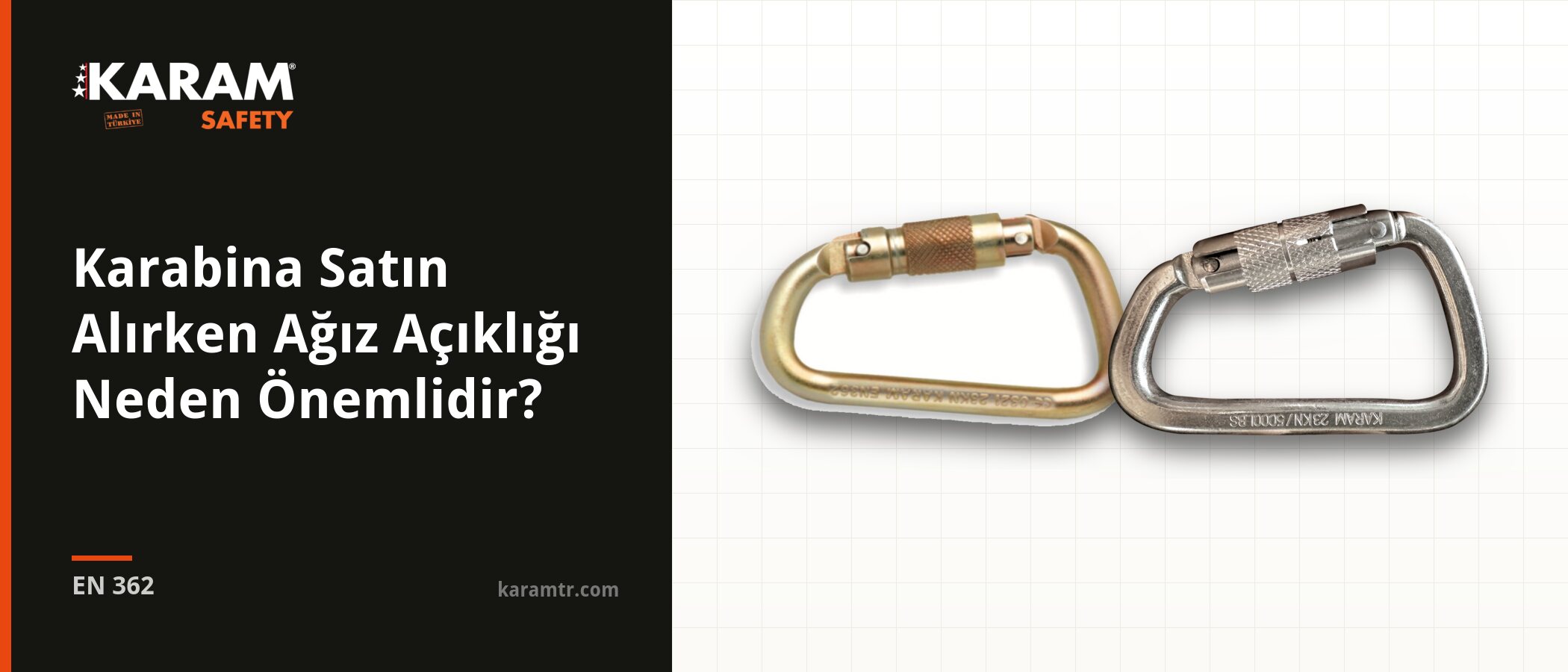
If workers will connect directly to a scaffold tube, the hook gate opening must be large enough to grip the tube's outside diameter comfortably. That is why lanyards for scaffold crews are ordered with the hook size specified. Karam offers large-hook options described in the product name as 63 mm and 110 mm.
KA341 A and KA361 A are described in their product names with a "63" aluminium hook, and KA341 BA with a "110" large aluminium hook. The KA341 manual also defines end connector options for the lanyard with gate openings of 16 mm, 18 mm, 55 mm, 60 mm and 110 mm; which end connector comes with the order should be confirmed. For aluminium hooks named "63", the exact gate opening should be confirmed from the product label and technical information. For details, see our article on hook gate opening for twin-leg lanyards, and for scaffold rules our article on safety harnesses for scaffold work.
If you would like to work out harness, lanyard and hook matching for your site's work packages together, you can send your crew list to Karam on WhatsApp; we will prepare the quotation based on that list.
How do you plan sizes and stock for subcontractors and multiple crews?
Size and stock planning is done from the personnel list using measurements, and every harness is issued to one person. According to Karam manuals, work-at-height products must be used on a personal basis. On sites with frequent subcontractor changes, this rule calls for personal issue and inspection records instead of a shared "pool harness" practice.
For the size distribution, waist, leg and height measurements are taken from the crew and matched to the size chart in the model's manual. Harness models are produced in different size ranges; for example, the KP45 technical data sheet lists sizes S/M, L/XL, XXL and XXXL. A single "standard size" order leads to harnesses that are either adjusted to their limit or left loose.
When planning stock, three items should be considered separately: harnesses issued per person, a short-term reserve for new starters, and the quantity needed to replace products withdrawn after a failed inspection. Because a product that has arrested a fall is withdrawn from use, a reserve stock also matters for keeping the work programme on track.
The service life is stated in the product's manual and can be shortened by conditions of use; a product that has arrested a fall or is damaged is withdrawn from use. So rather than building a large stock, buying in batches as needed, recording the production year on delivery and putting the older batch into service first is sound stock management.
What is checked at delivery acceptance?
At delivery acceptance, the product label, documents and visual condition are checked, then each harness is entered in the inspection logbook. This step forms the basis for later periodic inspection and issue tracking. The acceptance check also shows whether the order matches the specification.
- Label: product code, standard, serial number, batch number, size, year of production and the notified body number must be legible.
- The user manual must be supplied with each product and in the user's language.
- The EU type-examination certificate and EU declaration of conformity for the harness and lanyard must belong to the model ordered.
- Visual check: webbing wear and colour change, stitching, buckles and metal parts are inspected.
- On the lanyard, the energy absorber cover must be intact and the connector gates and locking mechanisms must work smoothly.
- Sizes and quantities are compared with the size distribution list.
- For each product, the serial number, production date, purchase date, date of first use, user's name and next periodic inspection date are written in the logbook.
Before first use, it is recommended that the user puts on and adjusts the harness in a safe area and sees whether size and comfort are suitable with a short suspension test. If this test is done on delivery day, any size change needed can be reported to the supplier immediately.
Purchasing checklist
The list below can be used when drafting a specification and comparing quotations. Each item should be covered by a document in the quotation file or at delivery acceptance.
- Work packages and the number of people in each are listed.
- The attachment points needed for each package (back, chest, side) are defined.
- The specification states EN 361 and, where needed, EN 358 / EN 813 instead of "construction harness".
- User and tool mass are compared with the documented capacity of the harness and the lanyard.
- Lanyard type (static rope or webbing), length and hook size are chosen per work package.
- Free height below the anchorage is compared with the requirement in the lanyard manual; if insufficient, a retractable fall arrester is considered.
- Anchor points are confirmed to comply with EN 795 and to have a strength of at least 12 kN.
- If kits are purchased, standards are confirmed from the components' own documents.
- Size distribution is drawn up from measurements and the reserve stock quantity is set.
- Suitable space for cleaning, drying and storage is planned on site.
- Certificates, declarations of conformity and manuals in the local language are requested on delivery.
- The logbook, issue records and an inspection by a competent person at least every 12 months are scheduled.
- User training and the rescue plan are prepared in parallel with the purchase.
Frequently Asked Questions
Which standard should a construction safety harness meet?
The basic standard for fall arrest is EN 361. If the worker will lean into the harness for work positioning, the harness should also conform to EN 358, and to EN 813 where prolonged suspension is possible. "Construction harness" is a trade term; the specification should rely on standard numbers and the harness's own certificate.
Can the same harness be bought for the whole crew?
It can, but it is usually not efficient. The formwork and rebar crew need side positioning rings, while a basic EN 361 harness with a back ring may be enough for scaffold and slab-edge crews. A mixed order by work package avoids both unnecessary weight and missing features.
Where should I check the standard of the lanyard in a kit?
Check it on the lanyard's own label, user manual and certificate. The kit page summarises the components; if the summary differs from the component's document, the component's document prevails. For KA341, the manual and certificate show conformity with EN 354:2010 and EN 355:2002.
Is the harness capacity the same as the lanyard capacity?
Not always. The maximum rated load is 150 kg for KP45 and 125 kg for KP30 and KP37, but the mass the system allows is set by the most limited component. Because the EN 355 test uses a 100 kg test mass, the lanyard's own documents should be checked separately for heavier users.
Can harnesses brought by subcontractors be used?
Harnesses with a legible label, a standard suited to the task, a periodic inspection record and a known history can be used after passing the acceptance check. According to the manuals, products with an unknown history, that have arrested a fall or are suspected of chemical contact must not be used. Issuing new personal equipment is safer in such cases.
How is a harness cleaned and stored on site?
According to the manuals, the harness is washed with water at no more than 30 °C and a neutral (pH 5.5) detergent, dried at room temperature and kept away from direct heat. It is stored in a dry place out of direct sunlight, away from acids and solvents. A damp product is not used until it has dried.
How often should harnesses be inspected?
The user carries out a visual check before every use, and a competent person carries out a periodic inspection at least every 12 months. Results are recorded in the logbook. A product found defective or that has arrested a fall is withdrawn from use and sent to the manufacturer for assessment.
How can I get pricing for a bulk order?
Because pricing depends on the model, lanyard type, hook option, size distribution and quantity, the best route is to request a quotation together with your crew list. If you send your work packages and headcount via WhatsApp, the Karam team will prepare a quotation with a suitable configuration.
Buying the right construction safety harness starts with a work package list, continues with a specification that includes standards and capacity, and is completed with delivery acceptance and personal records. Once this routine is in place, harness, lanyard and anchorage work on site as a system that complements each other. For configuration and quotation support for your site, contact Karam on WhatsApp.
Let our team recommend the best equipment for your needs and quote you quickly.