
In This Article
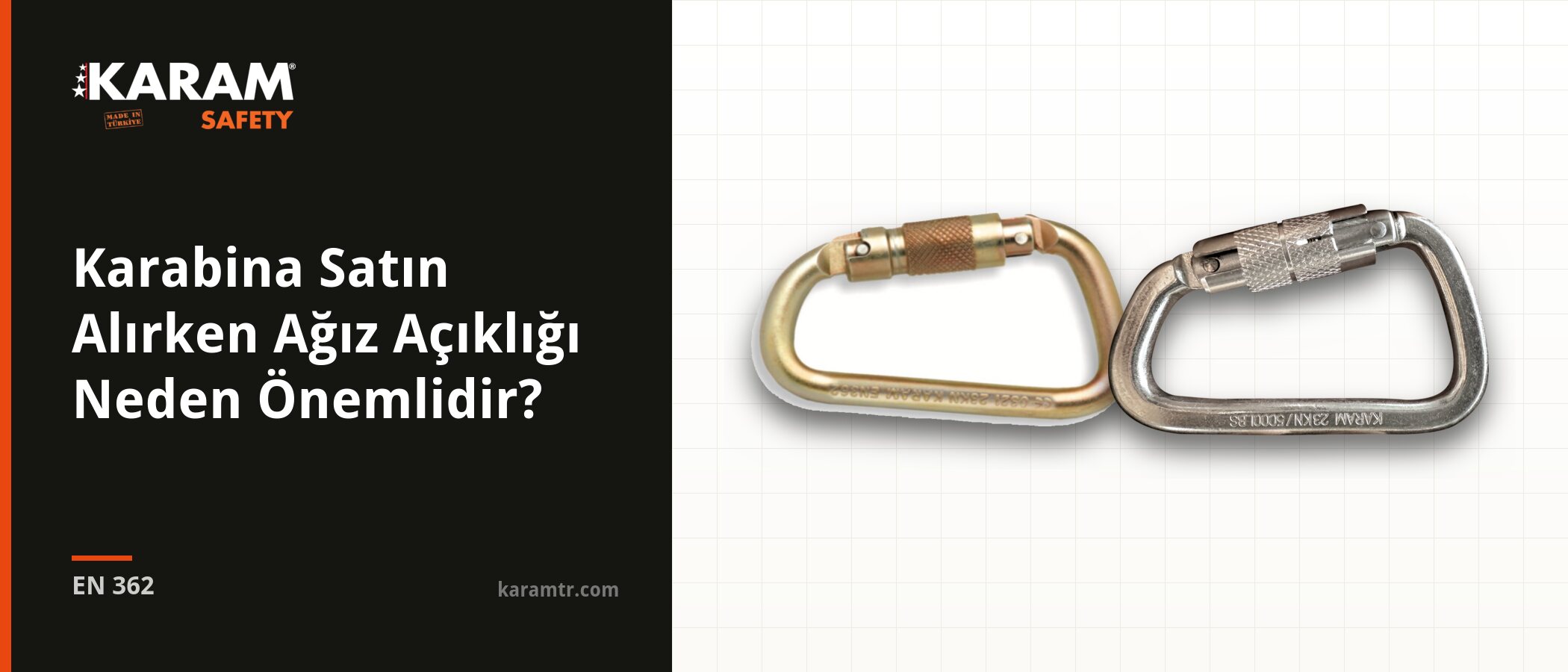
Carabiner gate opening is the widest distance between the inner edges of a carabiner when its gate is fully open, and it decides whether the connector seats correctly on the D-ring, anchor eye, sling or lifeline. If the opening does not suit the element, clipping becomes awkward, the carabiner can be loaded the wrong way and its kN rating no longer means what it promises.
What Is Carabiner Gate Opening?
Gate opening is the widest gap between the frame and the gate tip when the gate is pushed fully open: the space an element must pass through. It tells you what the carabiner can be clipped onto, not how strong it is, so it is read alongside the kN rating rather than instead of it.
The value is usually given in millimetres. Karam instructions for use list gate opening, material, strength and standard as separate carabiner data fields, so check the product data, marking and instructions instead of guessing. A calliper gives a rough check, but the purchase decision should rely on the value declared by the manufacturer.
Opening varies with frame shape, gate design and locking mechanism, and two carabiners with the same strength rating can differ clearly. "Same kN, same carabiner" is therefore a mistake: opening, shape and locking type are assessed together.
Why Does Gate Opening Matter So Much?
A carabiner bridges the harness D-ring, the lanyard eye and the anchor element. When the opening matches them, it settles along its major axis, the gate closes completely and the lock engages without effort. A mismatch causes small-looking errors that weaken the whole fall arrest system.
Fit to the Cross-Section of the Element
The right opening is slightly larger than the cross-section of the element, letting it sit freely without excessive room. Know the D-ring wire diameter, anchor eye plate thickness, sling webbing width or rope eye diameter in advance. If the element does not pass through the gate comfortably, the carabiner is probably wrong for that connection.
Problems With a Gate Opening That Is Too Narrow
A narrow opening pushes the user to tilt the carabiner, force the gate or squeeze the element through, straining the gate spring, locking sleeve and nose. The gate may also stay slightly open over the element; then the lock cannot engage and the carabiner works in its weakest condition. Gloves and cold weather increase this risk.
Problems With a Gate Opening That Is Too Wide
An unnecessarily wide opening and large frame let the carabiner rotate freely in a small ring, shifting load onto the gate, the nose or the minor axis instead of the spine. Wide-bodied connectors may also lever between the element and the gate. "The wider the better" is not true; the opening is chosen to suit the element.
Which Opening Suits Which Element?
An exact millimetre match is assessed for each product combination. The table below sums up what to measure and check before buying, so that the carabiner is selected for the element, not the other way round.
| Connection element | What to measure / check | Key point |
|---|---|---|
| Harness D-ring | Wire thickness and inner space of the ring | Stays on its major axis; must not rotate onto the gate |
| Anchor eye / anchor connector | Plate thickness and hole diameter | Anchor above the user, EN 795 compliant; gate clear of the eye's edge |
| Anchor sling | Webbing width and gathered cross-section | Sling spreads evenly at the base, never folded over the gate |
| Rope or lanyard eye | Eye diameter and protective sleeve | Eye stays at the narrow end, in line with the major axis |
| Lifeline | Rope, wire rope or rail cross-section | Slides smoothly; follow the connector specified in the system instructions |
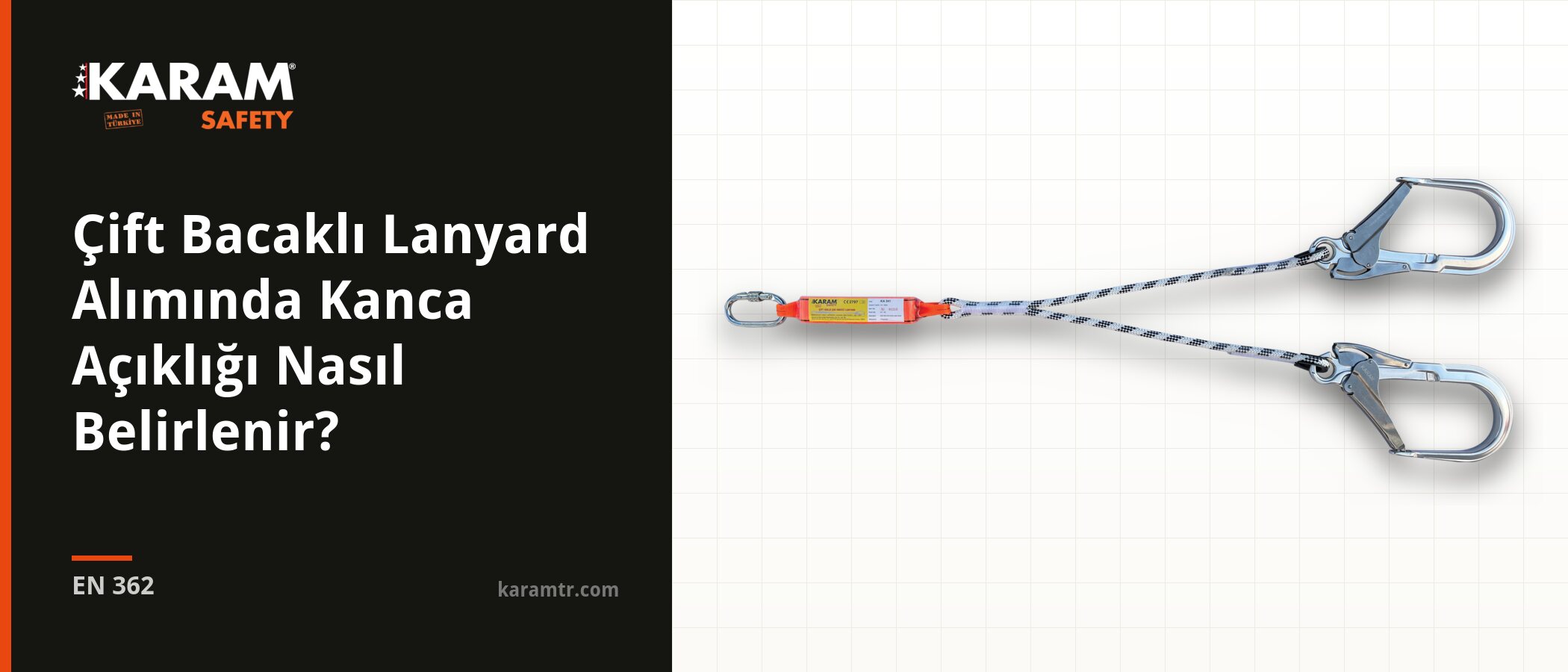
For a direct connection to a thick structural member, pipe or beam, the answer is often a large-opening hook or a suitable anchor sling rather than a carabiner. Hook opening on twin-leg lanyards is covered in our guide to twin-leg lanyard hook opening.
Gate Loading, Cross-Loading and Minor-Axis Load
Declared strength refers to loading along the major axis with the gate closed and locked. The Karam KA341 instructions for use require the gate to be locked at all times and the carabiner to be used along this axis, the direction of highest strength. An unsuitable opening makes it easy to slip out of it.
Gate Loading
Gate loading happens when an element or a structural edge presses against the gate and the load passes through it. The gate is the weakest part; even locked, it is not designed to carry load. It develops easily when a wide-bodied carabiner turns in a small ring or rests on an edge, so check after every connection that the gate is free.
Cross-Loading
Cross-loading occurs when several elements pull a carabiner in different directions, or when it turns sideways and is stretched between its side bars. The load then falls on the weak direction of the frame. Instead of clipping several elements in at random, follow the connection layout in the system instructions.
Minor-Axis and Three-Way Loading
Minor-axis loading acts across the short axis of the frame; three-way loading pulls it from three directions, as can happen when several elements gather in the wide base of a pear-shaped carabiner. In both cases strength falls well below the major-axis value. A suitable opening and the right shape reduce these risks from the start.
How Does Carabiner Shape Affect Gate Opening?
Shape determines both the gate opening and where the load concentrates inside the carabiner. Even carabiners with the same locking type perform differently depending on shape. The Karam range includes pear-shaped, D-shaped and standard-frame carabiners.
- Pear-shaped (HMS): A wide base and relatively wide gate opening accept slings or several elements comfortably, but can also leave room to rotate in a small ring, so check the loading direction. Example: KK113 Pear-Shaped Carabiner.
- D-shaped: The asymmetric frame directs load away from the gate towards the spine. It behaves steadily in single-element connections loaded along the major axis. Example: KK113 D-Shaped Carabiner.
- Oval: The symmetric frame centres the load; it is preferred when pairing with pulleys and some devices. Because it directs load towards the spine less than a D shape, selection should be made together with the strength information marked on the product.
When choosing a shape, consider the number of elements, how often the gate will be opened and whether the connection stays fixed or moves. Material matters too: with its aluminium frame and 80 g weight, KK119 is a light option where weight counts.
Locking Mechanisms Compared
The locking mechanism decides how easily the opening can be used and how the gate is protected against unintended opening. The Karam KA341 instructions recommend auto-locking carabiners because they keep the gate locked at all times. Three common types compare as follows.
| Locking type | How it works | Advantage | Watch out for | Typical use |
|---|---|---|---|---|
| Screw-lock (manual) | The gate closes by itself; the locking sleeve is screwed shut by hand | Simple, controlled closing for rarely opened connections | Can be left unscrewed; may loosen under vibration | Long-term fixed connections (e.g. KK112) |
| 2-stage auto-locking | The gate closes and locks by itself; two separate actions are needed to open it | Locking independent of memory; fast one-handed clipping | In dirt or dust, confirm the lock is fully engaged | Frequently clipped connections (e.g. KK113, KK119) |
| 3-stage auto-locking | The gate locks by itself; three separate actions are needed to open it | Extra protection against opening by rubbing or contact | Gloved use takes practice; try it in a safe area first | Mobile work with edge or structure contact (e.g. KK111, KK114) |
Whatever the type, check after every connection, by eye and with a light hand test, that the gate has closed and the lock has engaged. A lock does not prevent gate loading; it only prevents unintended opening. Without the right opening and direction, a good lock is not enough.
EN 362 Classes and kN Ratings
EN 362 covers connectors for personal fall protection systems and classifies them by intended use. In Türkiye these products are treated as Category III PPE under the PPE Regulation aligned with Regulation (EU) 2016/425.
| Class | Definition | Typical use |
|---|---|---|
| B | Basic connector | General connections between harness, lanyard and anchor |
| M | Multi-use connector | Declared for minor-axis as well as major-axis loading |
| T | Terminal connector | Subsystem ends such as lanyard ends, loaded in a defined direction |
| A | Anchor connector | Connectors designed to attach directly to a specific type of anchor |
| Q | Screw-link connector | Semi-permanent links opened and closed only with a tool |
The kN rating is the minimum static force the connector withstands in the stated direction, not the user's mass or a load capacity, and it is read together with gate opening. KK114, for example, is an EN 362:2004 Class B connector with a 22 mm gate opening and 40 kN minimum breaking strength. For comparison, the KK166 Electrician's Hook, a hook, is listed at 57 mm, 23 kN and EN 362:2004 Class T. The Karam KA341 instructions for use also define connector options ranging from a 16 mm carabiner to a 110 mm hook. Wide opening and high kN are different things that meet different needs.
A high kN rating does not make a carabiner safe if its opening does not suit the connection: under gate or minor-axis loading, real strength drops well below the marked value. Check opening and shape fit first, then strength and class. Product documents are on the Karam certificates page.
Gate Opening Data for Karam Carabiners
The Karam carabiner range covers different locking types and frame shapes. The table summarises verified information from the product pages and instructions for use. Where no gate opening is published, we do not estimate it; ask us and we will confirm it against your connection.
| Product | Locking / construction | Strength | Gate opening |
|---|---|---|---|
| KK114 3-stage auto-locking carabiner | 3-stage auto-locking, alloy steel, EN 362:2004 Class B | 40 kN | 22 mm |
| KK111 3-stage carabiner | 3-stage auto-locking, alloy steel, EN 362 | 25 kN | Ask to confirm |
| KK113 2-stage auto-locking carabiner | 2-stage auto-locking, alloy steel, EN 362 | 23 kN | Ask to confirm |
| KK113 Pear-Shaped | 2-stage auto-locking, alloy steel, EN 362 | 25 kN | Ask to confirm |
| KK113 D-Shaped | 2-stage auto-locking, alloy steel, EN 362 | 23 kN | Ask to confirm |
| KK119 aluminium carabiner | 2-action, aluminium, 80 g, EN 362 | 25 kN | Ask to confirm |
| KK112 screw-lock carabiner | Manual screw lock, steel, EN 362:2004 Class B | 25 kN | 16 mm (KA341 instructions for use) |
| KK166 electrician's hook (a hook, for comparison) | Steel-reinforced polymer, EN 362:2004 Class T | 23 kN | 57 mm |
KY 06, KY 08 and KY 10 galvanised spring-gate carabiners are described as rope holders for tensioning and light hanging loads. They are not PPE connectors and must not be used for fall arrest, positioning or harness-to-lanyard connections; only EN 362 compliant connectors belong in a work-at-height system.
If you would like to confirm which opening suits your harness D-ring, anchor or lanyard eye, you can send the element's size or a photo to the Karam team on WhatsApp; we will verify the product's gate opening and suggest a suitable carabiner.
Buying Checklist
These steps help purchasing and safety teams buying for several crews or sites assess gate opening together with the rest of the system.
- List every element the carabiner will connect to: harness D-ring, anchor eye, sling, rope eye or lifeline.
- Note the cross-section, wire or plate thickness of each element; take a photo if possible.
- Check the gate opening in the product data or marking; if missing, ask for written confirmation.
- Confirm the opening is slightly larger than the element, but not so large that the carabiner spins in a small ring.
- Choose the frame shape for the task: D-shaped for single-element connections, pear-shaped for multi-element connections.
- Choose the locking type for the work pattern: prefer auto-locking where connections are opened and closed often.
- Match EN 362 compliance, class and kN rating with the product marking and documents.
- Check connector requirements in the lanyard, harness and anchor instructions; Karam instructions for use are the basic reference.
- Remember the connector's effect on lanyard length: the 2 m maximum length of an energy-absorbing lanyard includes connectors. See our article on lanyard length and fall clearance.
- Give users a short practice session in clipping, locking and checking before first use.
Examples From the Field
These are general situations; on site, the final choice rests on the products' own instructions and a competent person's assessment.
Example 1: A Thick Anchor Eye
A maintenance crew can clip onto a thick anchor eye only by tilting the carabiner; the gate rubs on the edge and it is unclear whether it has closed. The fix is a carabiner whose opening suits the eye's cross-section, plus a check after every connection that the gate is free.
Example 2: A Wide Frame on a Small D-Ring
A wide pear-shaped carabiner on a slim D-ring keeps rotating and its gate sometimes rests on the ring, which sets the stage for gate loading. A D-shaped carabiner that directs load to the spine, or the connector specified by the harness manufacturer, gives a steadier result.
Example 3: A Connection Clipped and Unclipped All Day
A crew that changes anchors dozens of times a day uses screw-lock carabiners and sometimes forgets the sleeve. The problem is the locking type, not the opening; a 2-stage or 3-stage auto-locking carabiner takes locking out of the user's memory. Our article on choosing the right carabiner offers a general framework.
Pre-Use and Periodic Inspection
Even a correctly sized carabiner needs regular inspection. Karam instructions for use require metal parts to be checked for cracks, deformation and corrosion, in good light, with results recorded in the inspection log.
- Does the gate open freely and close fully by itself?
- Does the locking mechanism work smoothly at every stage and lock the gate completely?
- Are there burrs, dents, cracks or corrosion on the gate tip, nose or frame?
- Is the marking on the frame (standard, class, strength) legible?
- Has the carabiner been part of a system that arrested a fall? If so, withdraw the system and have it assessed by a competent person.
Beyond user checks, a competent person should examine equipment periodically in line with EN 365; the KA341 instructions require this at least every 12 months. A defective connector is withdrawn, never repaired.
Frequently Asked Questions
How is carabiner gate opening measured?
It is the widest distance between the inner edges with the gate fully open, usually in millimetres. A calliper gives a rough check, but buying decisions should rely on the manufacturer's data, the product marking and the instructions for use. If no figure is published, ask the supplier for written confirmation.
Is a wider gate opening always better?
No. A wide opening eases clipping onto thick elements, but on a small D-ring it can let the carabiner rotate and invite gate loading. The right opening is slightly larger than the element's cross-section and keeps the carabiner on its major axis, so the choice starts from the element.
What are the gate opening and strength of the KK114 carabiner?
According to its product page, the KK114 3-stage auto-locking carabiner has a 22 mm gate opening and 40 kN minimum breaking strength, and is an EN 362:2004 Class B connector made of alloy steel, weighing 233.4 g net. To confirm the fit, share your element's size with us on WhatsApp.
What is gate loading and how can it be prevented?
Gate loading means the load passes through the gate instead of the frame, and because the gate is the weakest part, strength drops markedly. Prevent it by choosing an opening that suits the connection and checking each time that the carabiner sits on its major axis with the gate clear of elements and edges.
Should I choose a screw-lock or an auto-locking carabiner?
For frequently clipped connections, auto-locking carabiners are practical and safe because locking does not depend on memory; the Karam KA341 instructions also recommend them. Screw-lock carabiners suit connections that stay fixed for long periods, provided the sleeve is checked as screwed shut every time.
Does the kN rating on the marking show the user's weight?
No. It is the minimum static force the connector withstands in the stated direction, usually along the major axis with the gate closed and locked. User mass, harness load capacity and connector strength are different concepts; system suitability is assessed with the harness, lanyard and anchor documents together.
Can a galvanised spring-gate carabiner be used for fall arrest?
No. Karam KY 06, KY 08 and KY 10 galvanised spring-gate carabiners are rope holders for tensioning and light hanging loads, not PPE connectors. For fall arrest, positioning and harness-to-lanyard connections, use only EN 362 compliant locking connectors from our carabiner range.
How can I find the gate opening of a Karam carabiner that does not list it?
Ask us instead of guessing. Send the size or a photo of the element on WhatsApp and we will confirm the product's technical data and suggest a carabiner that fits. Pricing and delivery for bulk orders can be requested through the same channel.
Carabiner selection is simpler when gate opening is read with shape, locking type, EN 362 class and kN rating. Share your connection elements and let us choose the right Karam carabiner together: send your sizes and quote request on WhatsApp.
Let our team recommend the best equipment for your needs and quote you quickly.