
In This Article
Lanyard length is determined by the fall clearance available below the work position: first measure the real distance between the anchor and the ground or the first obstacle, then add the lanyard length, the shock absorber deployment, the user's height and a safety margin. If the total is greater, the lanyard is unsuitable there and a shorter connection, higher anchor or different system is needed.
Why must lanyard length and fall clearance be considered together?
Because the longer the lanyard, the further the user travels before the fall is arrested. A shock absorber limits the impact force, but it does so by deploying, which uses up extra distance. If the space below you cannot accommodate that total distance, the user may reach the ground or a structure even though the system limits the force correctly.
That is why the question "which lanyard gives me more freedom of movement?" is not enough on its own. The right question is: "at this anchor point, with this combination of equipment, is there enough space left below the user once the fall has stopped?" For general lanyard types and applications, see our guide to choosing a lanyard for work at height; this article focuses only on measurements and fall clearance calculation.
The first limit to remember comes from EN 354: the total length of a shock-absorbing lanyard, including connectors and the energy absorber, may not exceed 2 m. However, the fact that 2 m is the legal maximum does not mean a 2 m lanyard is suitable at every work position. What decides suitability is the actual clearance on site.
What makes up the total fall distance?
The vertical distance a user travels from the starting position until the fall stops is made up of several parts. Each part changes with the product type, anchor position and the user, so the total cannot be expressed as one fixed number that applies everywhere.
- Free fall: the distance travelled before the lanyard becomes taut and the shock absorber starts to work. The lower the anchor and the more slack in the lanyard, the longer the free fall.
- Shock absorber deployment: the extension that occurs as the absorber's stitching tears to dissipate energy. Instructions give it as "the length of the shock absorber after tearing".
- User height and attachment point: the lanyard is attached to the "A"-marked fall arrest point on the harness; how far the feet sit below that point is part of the calculation.
- Safety margin: the space that must remain between the user's feet and the ground or obstacle once the fall is arrested.
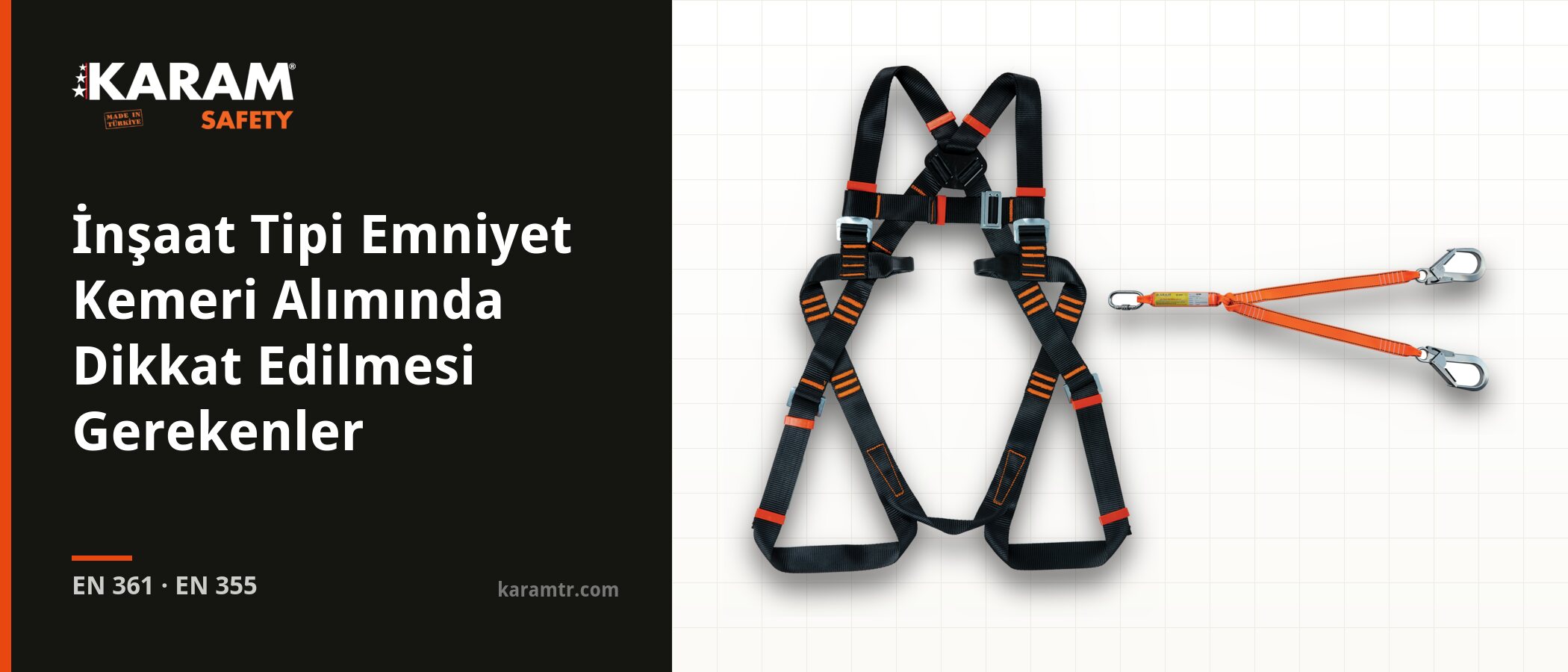
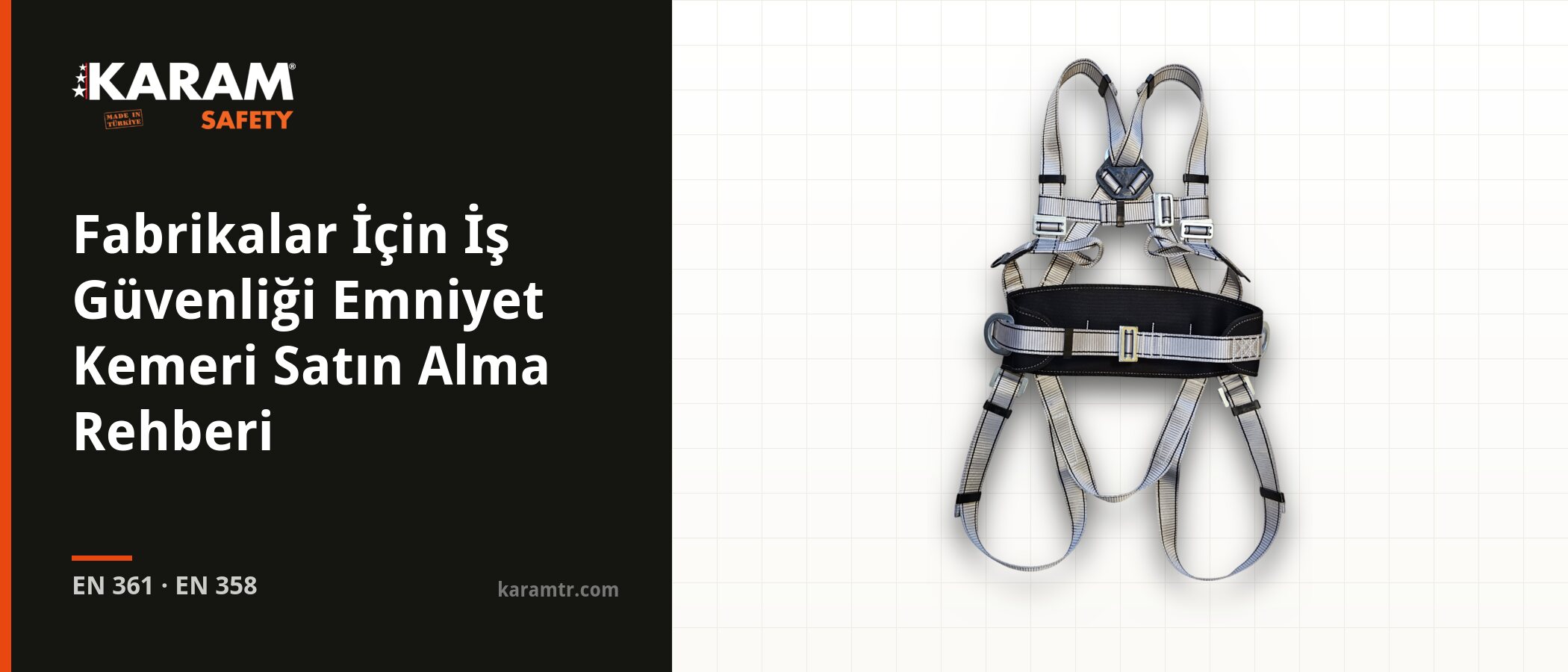
Karam harness instructions use the same logic: A stands for the length of a fall arrest lanyard or the locking distance of a mobile fall arrester, B for the length of the shock absorber after tearing, C for the user's height and D for the safety height. The values used always come from the instructions of the actual fall arrest device in the system.
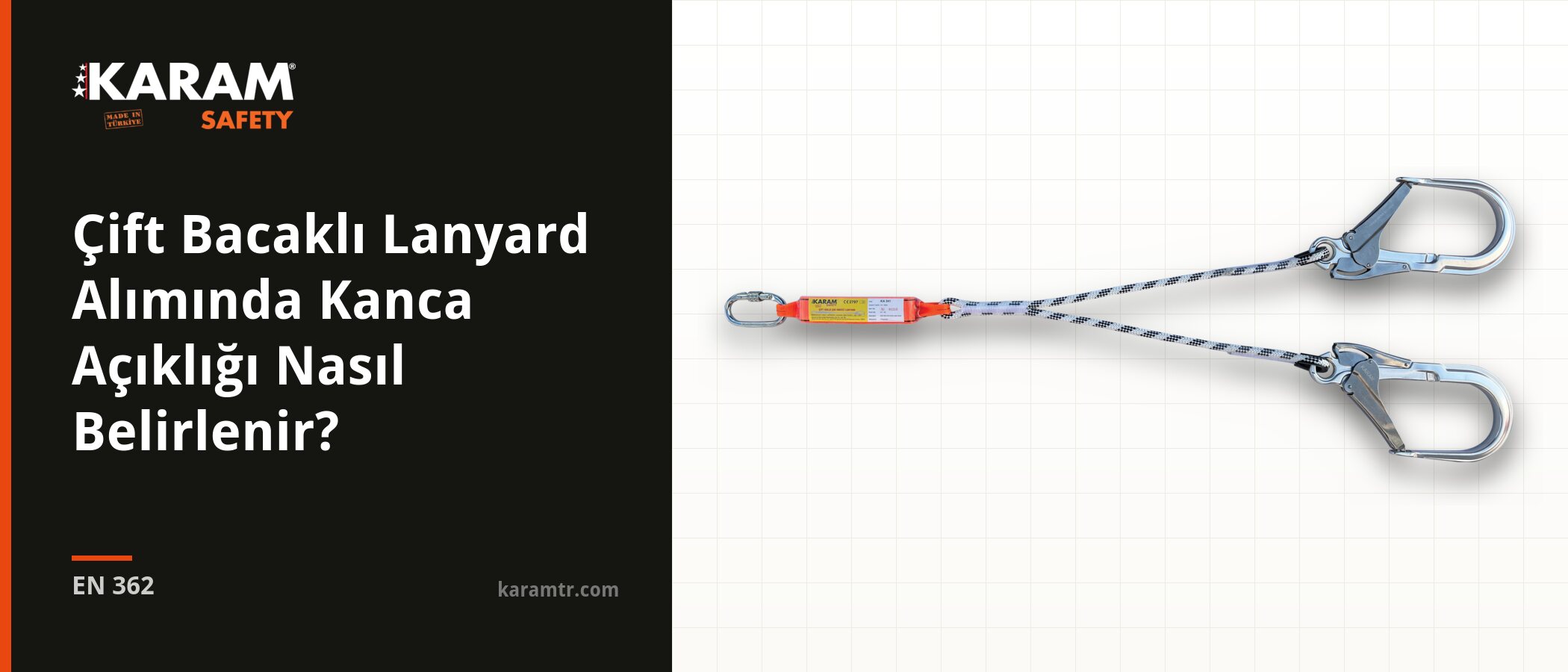
The A+B+C+D method in the KA341 user manual
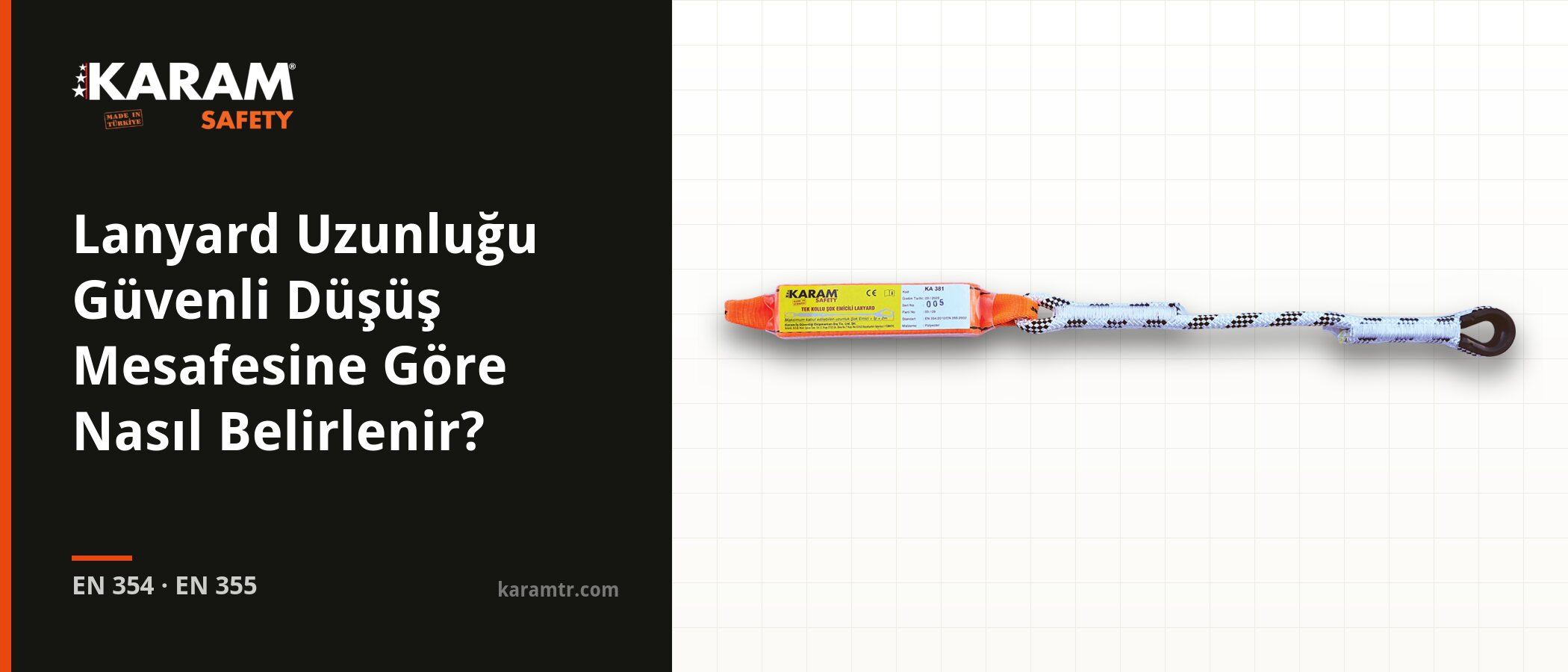
The manual of the KA341 twin-leg shock-absorbing lanyard defines fall clearance as the sum of four components and requires at least 6.25 m between the anchor point and the ground for this product. The values given in the manual are summarised below.
| Component | Definition in the manual | Value in the manual |
|---|---|---|
| A | Length of the shock absorber with lanyard and connectors | 2 m |
| B | Length of the shock absorber after tearing | 1.75 m |
| C | Height of the user (taken as at least 1.5 m, varies with the user) | 1.5 m |
| D | Safety margin between the user and the obstacle or ground | 1 m |
| Total | Minimum clearance between the anchor point and the ground/obstacle | 6.25 m |
The manual also explains that the special textile of the shock absorber starts tearing as the force approaches 6 kN, keeping the impact force transmitted to the user below 6 kN. In other words, the 1.75 m B value is the distance "paid" in exchange for limiting the force.
Why does 6.25 m apply only to the KA341?
The 6.25 m figure is given for the KA341's own design, its energy absorber and the assumptions in its manual. Another lanyard may have an absorber that extends differently, connectors of a different length, or a manufacturer-defined safety margin that differs. Using 6.25 m as a universal rule for all shock-absorbing lanyards is therefore not correct.
The same logic works the other way round. The KA341 product page lists rope length options of 1.20 m and 1.50 m, yet the manual gives 6.25 m as the minimum clearance for this product. Choosing a shorter rope does not automatically reduce the value written in the manual. A different clearance figure may only be used when it is confirmed by the product label, the manual or the manufacturer in writing.
How does anchor position change free fall?
The higher the anchor, the shorter the fall needed before the lanyard tightens. With the anchor above the user's head, free fall is at its lowest; at the level of the dorsal D-ring it is roughly the length of the lanyard; at foot level the height difference between the D-ring and the anchor is added to the lanyard length.
The KA341 manual requires the anchor point or system to always be above the user, to comply with EN 795 and to have a strength of at least 12 kN. Karam harness instructions also state clearly that the attachment point should preferably be above the user, or at least at waist level, and that an attachment point below this level can cause serious injury or death.
| Anchor position | Effect on free fall | Use with KA341 |
|---|---|---|
| Overhead | Shortest free fall; lowest total distance | The position the manual requires |
| Shoulder / D-ring level | Free fall roughly equal to lanyard length | Clearance must be checked carefully against the manual |
| Below waist / foot level | Free fall exceeds lanyard length; force and distance increase | Manual requires an anchor above the user; not suitable |
To create an attachment point at a suitable height, explore our EN 795 anchorage solutions. For example, the KA24 and KA20 anchor ears are listed on their product pages with 25 kN strength and EN 795 conformity, while the KA40 rebar anchor is listed as EN 795 Type B with 47.5 kN capacity, suitable for two users. Installation and the load-bearing capacity of the structure must be assessed by a competent person.
Representative examples: is the clearance sufficient?
The scenarios below are representative examples prepared only to illustrate the method. Real values on site are determined by the product's own manual, the combination of equipment in use and the assessment of a competent person. Each example is based on the 6.25 m minimum clearance stated in the KA341 manual.
Representative example 1: high roof truss
A maintenance team installs an overhead anchor on a roof truss about 8 m above the floor below. There is no pipe or beam in the fall path directly below the anchor. In this representative case, the anchor-to-ground clearance exceeds the 6.25 m given in the KA341 manual; even so, the fall path should be checked before each use and a rescue plan kept ready.
Representative example 2: mezzanine edge
In a warehouse, the anchor sits about 4.5 m above the floor below. In this representative case the clearance is below 6.25 m, so the KA341 is not suitable for fall arrest at this point. Options include raising the anchor, setting up a restraint arrangement that prevents the worker from reaching the edge, or considering another fall arrest system whose own manual gives values suitable for this clearance.
Representative example 3: obstacle at an intermediate level
Even if the anchor-to-ground distance is 7 m, a conveyor or platform 3 m below the work position means the calculation is made to the first obstacle, not to the ground. The D component in the manual also refers to an "obstacle" alongside the ground. In this representative case the usable clearance drops to 3 m and a shock-absorbing lanyard alone is not sufficient.
Why are user height and safety margin "minimum" values?
The KA341 manual takes the user's height as at least 1.5 m and notes that this value changes with the user. For a tall worker, the C component becomes larger. The safety margin in the manual's example is 1 m; it is the space left between the user's feet and the ground, and should not be treated as a reserve that can be trimmed.
Height, harness size and body mass are different things. Harness size (such as S/M or L/XL) concerns fit, while user mass is compared with the equipment's rated load. The EN 355 shock absorber test is carried out with a 100 kg test mass; use above 100 kg depends on testing documented by the manufacturer. On the harness side, the KP45 full body harness is defined with a maximum rated load of 150 kg, but this figure does not change the lanyard's clearance calculation by itself. For mass-based selection, read our article on choosing a full body harness by user weight.
What are the options when clearance is insufficient?
If the measured clearance does not meet the value the lanyard's manual requires, the aim is either to arrest the fall over a shorter distance or to stop the fall from starting at all. The options below should be handled within the risk assessment, giving priority to collective protection first.
- Raise the anchor: an overhead anchor shortens free fall. The anchor must comply with EN 795 and provide the strength the manual requires.
- Choose a shorter lanyard: single-leg static rope shock absorbers (such as KA381, KA383, KA387 and KA388) are listed with rope length options from 1.20 m to 2.00 m. Rope length is not the total lanyard length; the total length including the absorber and connectors, and the clearance value, must be confirmed from the label and manual.
- Use a retractable fall arrester: EN 360 retractable fall arresters keep the line taut and reduce slack. Harness instructions describe the A component for such devices as the "locking distance"; the clearance value and anchor position are taken from the device's own manual.
- Work positioning or restraint: systems that prevent the worker from reaching the fall hazard, or support them on a taut line, stop the fall from starting.
- Collective protection: guardrails, platforms or safety nets can reduce the need for personal fall arrest.
| Option | What it achieves | Point to watch |
|---|---|---|
| Raise the anchor | Shortens free fall | EN 795 conformity, structural capacity |
| Shorter lanyard | Reduces component A | Total length and clearance from the product manual |
| Retractable fall arrester (EN 360) | Reduces slack | The device's own clearance and anchor requirements |
| Work positioning (EN 358) | Supports the user on a taut line | Does not replace fall arrest |
| Restraint | Prevents reaching the edge | Line length must make the edge unreachable |
When are positioning lanyards the answer?
Adjustable work positioning lanyards (such as Kİ244, Kİ248-1 and Kİ248-3) let the user set their distance so they can work with both hands free. According to Karam harness instructions, for work positioning the anchor must be at or above waist level, the lanyard kept taut and free movement restricted to a maximum of 0.6 m. A positioning lanyard is not used for fall arrest; where there is a fall risk it must be combined with a separate fall arrest system.
Another important rule: the KA341 manual says the user should not adjust the length of the shock-absorbing lanyard where a fall is possible, and should always avoid slack in the lanyard. Length adjustments must be made in a safe position before starting work.
Swing fall and offset anchors
If the anchor is offset to one side rather than directly above the user, the fall follows an arc instead of a straight drop. This swing can make the user strike nearby structures and may load the lanyard over an edge. Because the user keeps descending until the lanyard reaches vertical, the vertical clearance required also increases.
- Place the anchor as close as possible to the vertical line above the work position; on wide work areas, move the anchor with the job or consider systems such as horizontal lifelines.
- The KA341 manual asks for adequate preventive measures if the risk analysis shows a possible fall over an edge, and for contact with sharp and abrasive edges to be avoided.
- The same manual requires the slope of the surface used as an anchorage not to exceed 15° and notes that on surfaces sloping more than 15°, falls of more than 2.4 m may occur.
Where does the unused leg of a twin-leg lanyard go?
On a twin-leg lanyard, only the leg in use is connected to the anchor; the free leg must not be attached to any loop or attachment element of the harness. The KA341 manual illustrates this rule with figures. Attaching the free leg to the harness can prevent the shock absorber from working correctly during a fall and can create additional loading.
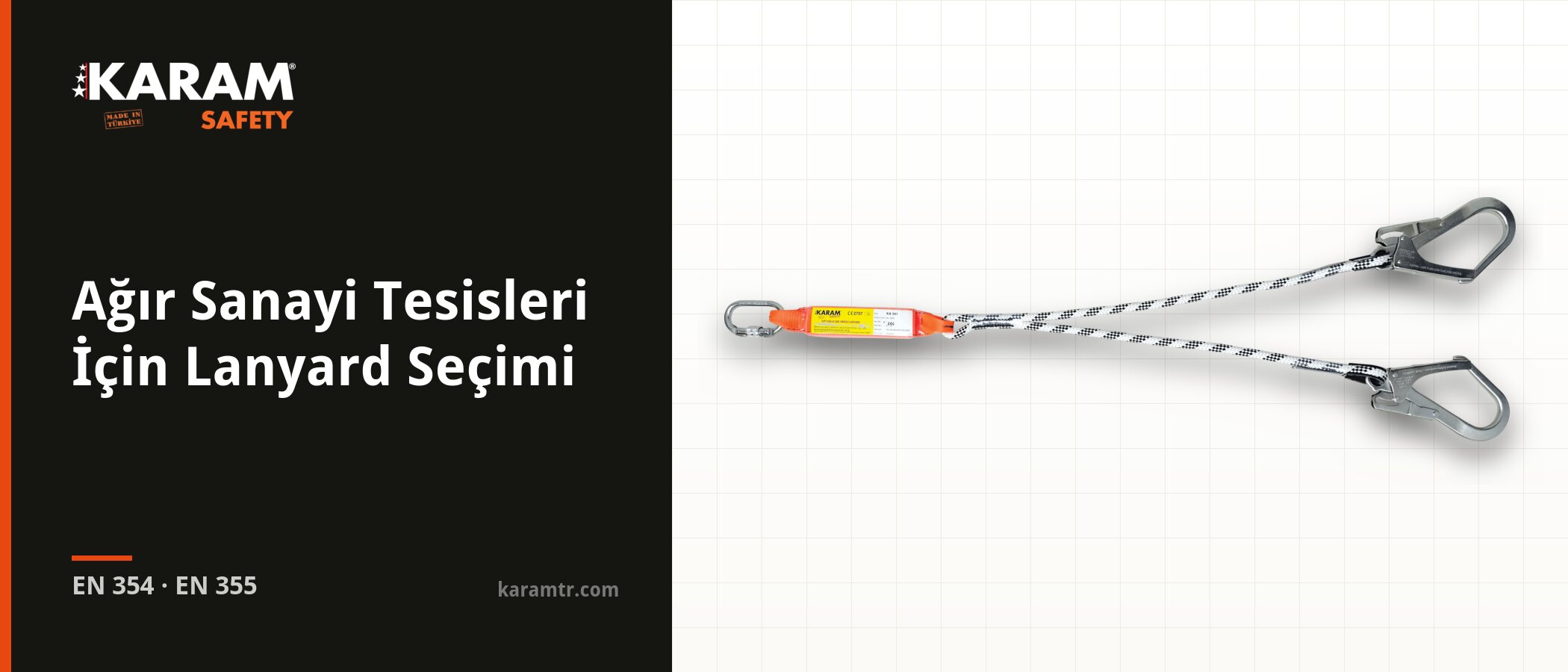
The manual also states that two separate single-leg shock-absorbing lanyards must not be used side by side (in parallel); a "Y" or "V" twin-leg lanyard with one shock absorber should be used instead. When checking clearance, consider whether the hanging free leg could snag on an obstacle. To see how continuous attachment is kept during leg transfers, read our twin-leg versus single-leg lanyard comparison.
How do you check clearance on site?
The calculation is done at the work position, not at a desk. The sequence below is a practical checklist for taking the manual's components onto site.
- Read the user manuals of the lanyard and harness; note the clearance value and anchor requirements.
- Confirm that the anchor point is above the user, complies with EN 795 and has the strength the manual requires.
- Measure the distance from the anchor down to the first obstacle or the ground in the fall path.
- Compare it with the clearance value in the manual; if the user is taller than the manual's assumption, account for the difference.
- Check lateral offset and possible swing; take measures if edges or sharp surfaces are present.
- Leave no slack in the lanyard and never attach the free leg to the harness.
- Confirm that a rescue plan and trained personnel are in place.
The manual requires a user check before each use and a periodic inspection by a competent person at least every 12 months; a product that has arrested a fall must be withdrawn from use. Product manuals are available on our user manuals page.
What information should you prepare before buying?
Asking a supplier only "how many metres?" is not enough to determine the correct lanyard length. Recommendations become far more accurate when the following information is ready.
- Anchor position: overhead, shoulder level or lower.
- Measured distance between the anchor and the ground or first obstacle.
- Whether the worker stays in one place or moves sideways and up and down.
- Whether there are edges, sharp surfaces or sloping work surfaces.
- Users' height range and mass including equipment.
- Current harness model and its attachment points.
Send us this information and we can review suitable lanyard, anchorage or retractable options together. Share your work position measurements on WhatsApp and our team will guide you according to the product manuals.
Frequently Asked Questions
What is the maximum lanyard length?
Under EN 354, the total length of a shock-absorbing lanyard, including connectors and the energy absorber, may not exceed 2 m. The KA341 manual repeats this limit. It is a legal maximum, however; if the clearance at the work position is insufficient, a 2 m lanyard may not be suitable. Always select according to the measured clearance and the product's own manual.
Is the required fall clearance 6.25 m for every lanyard?
No. 6.25 m is the minimum anchor-to-ground clearance given in the KA341 user manual for this product, built from the components 2 + 1.75 + 1.5 + 1. A different shock absorber, connector or system may require a different value. For each product, the clearance value on its own label and in its own manual applies.
If I choose a shorter rope, does the required clearance drop automatically?
Do not assume it does. Rope length is only part of the total lanyard length; the absorber body and connectors are also included. And if the manual defines a specific minimum clearance for the product, that value applies. A different clearance figure should only be used when confirmed by the product label, manual or the manufacturer in writing.
Can a shock-absorbing lanyard be used with a foot-level anchor?
The KA341 manual requires the anchor point always to be above the user. Karam harness instructions also warn that an attachment point below waist level can cause serious injury. A foot-level anchor lengthens free fall. In this situation, raising the anchor or using a solution such as a restraint system should be considered.
What is shock absorber deployment?
It is the extension of the shock absorber as its stitching tears to dissipate energy during a fall. The KA341 manual gives the length of the shock absorber after tearing as 1.75 m and uses it as component B in the clearance calculation. Because this value can differ between products, always refer to the manual of the product you use.
Does a retractable fall arrester solve a clearance problem?
In many cases it is one of the options worth considering, because it reduces slack. For EN 360 retractable fall arresters, component A in the clearance calculation is the device's locking distance. However, anchor position, edge use and the required clearance vary from device to device, so the decision must be based on the device's own user manual.
Can a positioning lanyard replace a fall arrest lanyard?
No. A positioning lanyard supports the user on a taut line so they can work with both hands; it is not used for fall arrest. According to the instructions, the anchor must be at or above waist level and free movement restricted to a maximum of 0.6 m. If a fall risk exists, a separate fall arrest system must be installed.
How can I get prices for lanyards and anchorage products?
Prices are not published on the pages because they depend on product type, rope length, hook choice and quantity. Send the product codes you need and the measurements of your work position to our WhatsApp line, and we will reply with suitable products and up-to-date quotation details.
When determining lanyard length, take the measurement on site, read the value from the product's own manual and complete the calculation with a competent person's assessment. For the general working principle of fall arrest systems, our article on how fall arrest systems work is a good starting point.
Let our team recommend the best equipment for your needs and quote you quickly.